

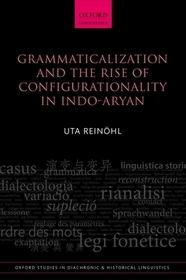
Grammaticalization and the Rise of Configurationality in Indo-Aryan
Series: Oxford Studies in Diachronic and Historical Linguistics;
- Publisher's listprice GBP 117.50
-
53 051 Ft (50 525 Ft + 5% VAT)
The price is estimated because at the time of ordering we do not know what conversion rates will apply to HUF / product currency when the book arrives. In case HUF is weaker, the price increases slightly, in case HUF is stronger, the price goes lower slightly.
- Discount 10% (cc. 5 305 Ft off)
- Discounted price 47 746 Ft (45 473 Ft + 5% VAT)
Subcribe now and take benefit of a favourable price.
Subscribe
53 051 Ft

Availability
printed on demand
Why don't you give exact delivery time?
Delivery time is estimated on our previous experiences. We give estimations only, because we order from outside Hungary, and the delivery time mainly depends on how quickly the publisher supplies the book. Faster or slower deliveries both happen, but we do our best to supply as quickly as possible.
Product details:
- Publisher OUP Oxford
- Date of Publication 12 May 2016
- ISBN 9780198736660
- Binding Hardback
- No. of pages252 pages
- Size 242x163x20 mm
- Weight 510 g
- Language English 0
Categories
Short description:
This book examines historical changes in the grammar of the Indo-Aryan languages from the period of their earliest attestations in Vedic Sanskrit (around 1000 BC) to contemporary Hindi, with specific focus on the rise of configurational structure as a by-product of the grammaticalization of postpositions.
MoreLong description:
This book examines historical changes in the grammar of the Indo-Aryan languages from the period of their earliest attestations in Vedic Sanskrit (around 1000 bc) to contemporary Hindi. Uta Rein--hl focuses specifically on the rise of configurational structure as a by-product of the grammaticalization of postpositions: while Vedic Sanskrit lacks function words that constrain nominal expressions into phrasal units - one of the characteristics of a non-configurational language - New Indo-Aryan languages have postpositions which organize nominal expressions into postpositional phrases. The grammaticalization of postpositions and the concomitant syntactic changes are traced through the three millennia of Indo-Aryan attested history with a focus on Vedic Sanskrit, Middle Indic Pali and Apabhramsha, Early New Indic Old Awadhi, and finally Hindi. Among the topics discussed are the constructions in which the postpositions grammaticalize, the origins of the postpositional template, and the paradigmatization of the various elements involved into a single functional class of postpositions. The book outlines how it is semantic and pragmatic changes that induce changes on the expression side, ultimately resulting in the establishment of phrasal, and thus low-level configurational, syntax.
Well organized, clearly and engagingly written, and offers a fine blend of theoretical relevance and close textual analysis [Rein--hls] arguments are thought provoking and well presented, and definitely demand close consideration by scholars of Indo -- Aryan and anyone interested in grammaticalization and Indo -- European diachronic syntax.
Table of Contents:
Series preface
Acknowledgements
Abbreviations
Introduction
Grammaticalization and configurationality
The diverse origins of the Hindi simple postpositions
Local particles: The unique source of adpositions and configurationality in Indo-European?
The components of the source constructions
The origin of the postpositional syntagm
From group to phrase
Paradigmatization: A process sui generis?
Conclusion
Appendix: Attested examples of madhye/upari
References
Index

