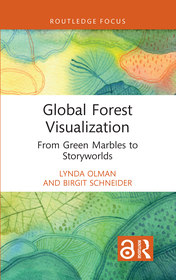
Global Forest Visualization
From Green Marbles to Storyworlds
Series: Routledge Focus on Environment and Sustainability;
- Publisher's listprice GBP 21.99
-
10 505 Ft (10 005 Ft + 5% VAT)
The price is estimated because at the time of ordering we do not know what conversion rates will apply to HUF / product currency when the book arrives. In case HUF is weaker, the price increases slightly, in case HUF is stronger, the price goes lower slightly.
- Discount 10% (cc. 1 051 Ft off)
- Discounted price 9 455 Ft (9 005 Ft + 5% VAT)
Subcribe now and take benefit of a favourable price.
Subscribe
10 505 Ft

Availability
Estimated delivery time: In stock at the publisher, but not at Prospero's office. Delivery time approx. 3-5 weeks.
Not in stock at Prospero.
Why don't you give exact delivery time?
Delivery time is estimated on our previous experiences. We give estimations only, because we order from outside Hungary, and the delivery time mainly depends on how quickly the publisher supplies the book. Faster or slower deliveries both happen, but we do our best to supply as quickly as possible.
Product details:
- Edition number 1
- Publisher Routledge
- Date of Publication 27 June 2025
- ISBN 9781032454016
- Binding Paperback
- No. of pages112 pages
- Size 216x138 mm
- Weight 210 g
- Language English
- Illustrations 14 Illustrations, color; 14 Halftones, color; 1 Tables, black & white 674
Categories
Short description:
This book project examines global forest monitoring as a means to understand the promises and problems of global visualization for climate management.
MoreLong description:
This book project examines global forest monitoring as a means to understand the promises and problems of global visualization for climate management.
Specifically, the book focuses on Global Forest Watch, the most developed and widely available forest-monitoring platform, created in 1997 by the World Resource Institute. Forest maps are always political as they visualize power relations and form the grid within which forests become commodities. This dislocation of the idea of the forest from its literal roots in the ground has generated problems for forest visualization efforts designed to empower local communities. This book takes a critical humanistic approach to this problem, combining methods from the fields of rhetoric and media studies to suggest solutions to these problems for designers and users of platforms like the Global Forest Watch. To explain why global views of forests can be disempowering, the book relies on biopolitical and rhetorical theories of panopticism and how these views unfold a different violence on different regions of the Earth in relation to colonial history. Using this theoretical framework, the book explains the historical process by which forests came to be classified, quantified, and mapped on a global scale. Interviews with end-users of global forest visualization platforms reveal if and how these platforms support local action. Lastly, the book provides rhetorical solutions to articulate global and local views of forests without reducing one view to the other. These solutions involve looking to forests themselves for clues about how to generate more broadly effective and resilient visualizations.
This book will be of great interest to students and scholars of forest studies, climate change, science communication, visualization studies, environmental communication, and environmental conservation.
The Open Access version of this book, available at http://www.taylorfrancis.com, has been made available under a Creative Commons Attribution-Non Commercial-No Derivatives (CC-BY-NC-ND) 4.0 license.
**Winner of the 2025 National Communication Association’s Tarla Rai Peterson Book Award in Environmental Communication**
MoreTable of Contents:
Chapter One—The Promises and Problems of Global Forest Visualization
Chapter Two—Forest Maps: The Datafication of Forests From a Media Theory Perspective
Chapter Three—Zooming Into Google Gaia Maps: From Globalization to Glocalization of Forests
Chapter Four—Forests as Stories: Storyworld Networks as Alternatives to Google Gaia
Chapter Five—Case Study: Global Forest Watch
Chapter Six—Insights From Developers and Users of GFW
Chapter Seven—From Green Marbles to Storyworlds
More