

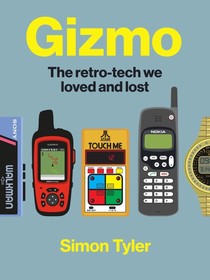
Gizmo
The retro-tech we loved and lost
-
GET 18% OFF
- Publisher's listprice GBP 25.00
-
11 287 Ft (10 750 Ft + 5% VAT)
The price is estimated because at the time of ordering we do not know what conversion rates will apply to HUF / product currency when the book arrives. In case HUF is weaker, the price increases slightly, in case HUF is stronger, the price goes lower slightly.
- Discount 18% (cc. 2 031 Ft off)
- Discounted price 9 256 Ft (8 815 Ft + 5% VAT)
- Discount is valid until: 31 August 2026
9 256 Ft

Availability
Not yet published.
Why don't you give exact delivery time?
Delivery time is estimated on our previous experiences. We give estimations only, because we order from outside Hungary, and the delivery time mainly depends on how quickly the publisher supplies the book. Faster or slower deliveries both happen, but we do our best to supply as quickly as possible.
Product details:
- Publisher Orion
- Date of Publication 14 May 2026
- ISBN 9780857829047
- Binding Hardback
- No. of pages224 pages
- Size 258x198x20 mm
- Weight 940 g
- Language English
- Illustrations 290 678
Categories
Long description:
We live in a world where many aspects of late twentieth century science fiction have become technological reality. As gadgets and technology in general have become more miniaturised, sleek and capable, so too has an appetite for the sort of quirky, retro tech that wistfully reminds us of earlier times. Nintendo has enjoyed great success with the re-release of their console systems from the 1980s, and US brand Analogue has created a hardware emulator for Sega's classic Mega Drive games. Audio formats such as vinyl records and cassettes have seen a resurgence, along with the devices that can play them.
This book sets out to provide a comprehensive survey of electronic and time-saving gadgets and devices, their evolution and genealogy, revealing where they come from, and how they are developed. In charting the diverse spectrum of gizmos by type and purpose, it uncovers the sometimes unexpected connections between them. Finally, we discover how these technologies have become the nexus of our interaction with each other and the world around us, shaping creativity and culture, storing memories, helping, guiding and, increasingly, thinking for us.

