

- Publisher's listprice GBP 155.00
-
69 982 Ft (66 650 Ft + 5% VAT)
The price is estimated because at the time of ordering we do not know what conversion rates will apply to HUF / product currency when the book arrives. In case HUF is weaker, the price increases slightly, in case HUF is stronger, the price goes lower slightly.
- Discount 20% (cc. 13 996 Ft off)
- Discounted price 55 986 Ft (53 320 Ft + 5% VAT)
- Discount is valid until: 30 June 2026
Subcribe now and take benefit of a favourable price.
Subscribe
62 984 Ft

Availability
Not yet published.
Why don't you give exact delivery time?
Delivery time is estimated on our previous experiences. We give estimations only, because we order from outside Hungary, and the delivery time mainly depends on how quickly the publisher supplies the book. Faster or slower deliveries both happen, but we do our best to supply as quickly as possible.
Product details:
- Edition number 1
- Publisher Routledge
- Date of Publication 17 July 2026
- ISBN 9781041234845
- Binding Hardback
- No. of pages258 pages
- Size 234x156 mm
- Language English
- Illustrations 1 Tables, black & white 700
Categories
Short description:
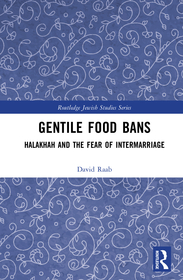
Gentile Food Bans: Halakhah and the Fear of Intermarriage challenges long-standing rabbinic and scholarly assumptions about the origins of dietary restrictions in Jewish law.
More
Long description:
Gentile Food Bans: Halakhah and the Fear of Intermarriage challenges long-standing rabbinic and scholarly assumptions about the origins of dietary restrictions in Jewish law.
Re-examining halakhic texts across centuries, this book argues that the early prohibitions against consuming Gentile bread and certain cooked foods were originally rooted in concerns over forbidden ingredients - not intermarriage. It was only later, in Babylonia, that the rationale of preventing intermarriage, mišum ḥatnut (mishum hatnut), was introduced, particularly regarding Gentile bread, even when prepared under rabbinic supervision. Drawing on a wide range of sources - including biblical texts, Second Temple writings, tannaitic literature, and the Palestinian Talmud - this study shows that intermarriage was not a major societal concern or halakhic foundation in ʾEreṣ Israel, whereas the Babylonian context likely prompted the shift in rationale. The book presents a compelling socio-historical argument for how evolving communal realities shaped halakhic interpretation and enforcement.
This work will appeal to scholars and students of Jewish studies, halakhah, rabbinics, and ancient Near Eastern history, as well as anyone interested in how legal traditions adapt to shifting cultural landscapes. It offers a fresh and rigorously documented perspective on the intersection of food, law, and identity in Jewish history.
"In this clearly written and impressively comprehensive study, David Raab challenges traditional and scholarly understandings of rabbinic bans on gentile foods, particularly in the Babylonian Talmud. By surveying relevant biblical and Second Temple era texts, closely rereading rabbinic passages and then correlating his findings with an understanding of the context of these works, Raab revises our understanding of this important aspect of halakha."
Shai Secunda, Jacob Neusner Professor of Judaism, Bard College.
"The examination in Gentile Food Bans of the societies and intermarriage in Israel and Babylonia in Late Antiquity, seeking to understand the evolution and social underpinnings of certain commensal prohibitions, is thought-provoking and illuminating. Although analyzing long-gone societies based on limited extant data is always challenging, Raab’s work presents a cogent case for his arguments. His framework for assessing a society’s predisposition to intermarriage is particularly innovative and may be useful in other contexts as well."
Nissan Rubin, Professor Emeritus, Department of Sociology and Anthropology, Bar Ilan University.
"Gentile Food Bans is an original work that employs a deep analysis both of Jewish literature and of available historical evidence to demonstrate how societal factors appear to have affected the evolution of early rabbinic law. Even a cursory scan will reveal the enormous amount of research and the breadth of sources that were brought to bear on Raab’s hypotheses. Though the book focuses on intermarriage and the avoidance of Gentile-prepared bread and cooking, its novel approach also offers the reader an insight into the development of halakhah. This work is a serious contribution to scholarship and should be read by scholars and interested parties in the field."
Simcha Fishbane, Professor of Jewish Studies, Graduate School of Jewish Studies, Touro University.
"David Raab’s learned, insightfully-argued, and well-written book offers a model for exploring the time-bound and geographically-based social and cultural concerns underlying rabbinic halakhic norms—indeed any community’s historical norms—and their subsequent interpretation and application through the ages. His work analyzes the marked evolution of the rationale for forbidding Jews to consume bread and foodstuffs prepared by Gentiles—from preoccupation simply about the ingredients used, to worries about social and religious assimilation. I highly recommend David Raab’s book."
Jack N. Lightstone, Professor Emeritus, Department of History, Brock University and Distinguished Professor Emeritus, Department of Religions and Cultures, Concordia University.
MoreTable of Contents:
CONTENTS
ACKNOWLEDGMENTS
TEXTS AND TRANSLATIONS
1. UPENDING CONVENTIONAL WISDOM
Background and Key Assertions
Structure of this Book
A Few Words on Methodology
2. PRE-RABBINIC AVOIDANCE OF GENTILE FOODS
Biblical Sources
Apocrypha
Pseudepigrapha
Dead Sea Scrolls
Josephus
New Testament Sources
Conclusion Regarding Second Temple and Earlier Literature
3. TANNAITIC BANS: THE INGREDIENTS, NOT THE PREPARER
Gentile Bread and Oil: A Problem Only of Ingredients
The Eighteen Edicts and Gentile Bread and Oil
Other Gentile Foods: Also, a Problem Only of Ingredients
Gentile Cheese: Yes, an Ingredients Issue
The Problem was Not the Baker or Chef
No Social Engineering Objective
No Prohibition of Eating with Gentiles
No Gentile Impurity Problem
Conclusion: Tannaitic Food Prohibitions are not Concerned about Intermarriage
4. LAND OF ISRAEL AMORAIC BANS: STILL THE INGREDIENTS
Yerushalmi Sources
Gentile Bread: Ingredients, not the Baker
Gentile Cooking Ban: If at All, Likely Introduced Late
Gentile Foods: Ingredients, not Intermarriage
Samaritan Foods
Gentile-Roasted Eggs
Gentile Lupines
Gentile Dumplings
Gentile-Smoked Foods
Gentile Fish Sauce
Gentile Cheese
Gentile Olive Oil
The Eighteen Edicts
Gentile Daughters and Benoteihen
Conclusion
5. THE BAVLI: FEAR OF INTERMARRIAGE
Gentile Bread and the Eighteen Edicts
Gentile Beer: A New Babylonian Prohibition
Gentile Oil
Gentile Cooking Generally: Chef Problem, but no Mention of Intermarriage
Conclusion
6. PARSING SOCIETIES REGARDING INTERMARRIAGE
A SOCIETAL HYPOTHESIS
A FRAMEWORK TO ANALYZE SOCIETAL PROPENSITY TO INTERMARRIAGE
Affinity-Opportunity Matrix
Attachment to the Group
CHALLENGES IN ANALYZING THE SOCIETIES
7. TANNAITIC ISRAEL: NO INTERMARRIAGE PROBLEM
SOCIETAL PREDISPOSITION TOWARDS INTERMARRIAGE
Tannaitic Jewish Society
Opportunity
Affinity
Conclusion
THE INTERMARRIAGE PHENOMENON AND RABBINIC PERCEPTIONS
8. AMORAIC ISRAEL: LITTLE INTERMARRIAGE PROBLEM
SOCIETAL PREDISPOSITION TOWARDS INTERMARRIAGE
Opportunity
Affinity
Conclusion
THE INTERMARRIAGE PHENOMENON AND RABBINIC PERCEPTIONS
9. AMORAIC BABYLONIA: INTERMARRIAGE PROBLEM
SOCIETAL PREDISPOSITION TOWARDS INTERMARRIAGE
Opportunity
Affinity
Conclusion
THE INTERMARRIAGE PHENOMENON AND RABBINIC PERCEPTIONS
10. CASE CLOSED
Difference 30: Throwing a Wood Chip into the Bread Oven
Difference 53: Seethed Gentile Beans
In Conclusion
BIBLIOGRAPHY
More

