

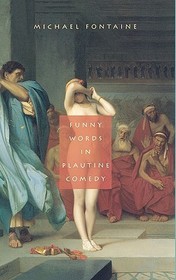
Funny Words in Plautine Comedy
- Publisher's listprice GBP 105.00
-
47 407 Ft (45 150 Ft + 5% VAT)
The price is estimated because at the time of ordering we do not know what conversion rates will apply to HUF / product currency when the book arrives. In case HUF is weaker, the price increases slightly, in case HUF is stronger, the price goes lower slightly.
- Discount 10% (cc. 4 741 Ft off)
- Discounted price 42 667 Ft (40 635 Ft + 5% VAT)
Subcribe now and take benefit of a favourable price.
Subscribe
47 407 Ft

Availability
printed on demand
Why don't you give exact delivery time?
Delivery time is estimated on our previous experiences. We give estimations only, because we order from outside Hungary, and the delivery time mainly depends on how quickly the publisher supplies the book. Faster or slower deliveries both happen, but we do our best to supply as quickly as possible.
Product details:
- Publisher OUP USA
- Date of Publication 14 January 2010
- ISBN 9780195341447
- Binding Hardback
- No. of pages328 pages
- Size 152x229x22 mm
- Weight 649 g
- Language English
- Illustrations 7 black and white halftones 0
Categories
Short description:
Combining textual and literary evidence, this book argues that many Plautine jokes, puns, and names of characters were misunderstood in antiquity. By examining the comedian's tendency to make up and misuse words, Fontaine elucidates many new jokes and argues for a sophisticated, Hellenistic Plautus who wrote for a sophisticated Roman audience.
MoreLong description:
Plautus, Rome's earliest extant poet, was acclaimed by ancient critics above all for his mastery of language and his felicitous jokes; and yet in modern times relatively little attention has been devoted to elucidating these elements fully. In Funny Words in Plautine Comedy, Michael Fontaine reassesses some of the premises and nature of Plautus' comedies. Mixing textual and literary criticism, Fontaine argues that many of Plautus' jokes and puns were misunderstood already in antiquity, and that with them the names and identities of some familiar characters were misconceived. Central to his study are issues of Plautine language, style, psychology, coherence of characterization, and irony. By examining the comedian's tendency to make up and misuse words, Fontaine sheds new light on the close connection between Greek and Roman comedy. Considerable attention is also paid to Plautus' audience and to the visual elements in his plays. The result is a reappraisal that will challenge many received views of Plautus, positioning him as a poet writing in the Hellenistic tradition for a knowledgeable and sophisticated audience. All quotations from Latin, Greek, and other foreign languages are translated. Extensive indices, including a "pundex," facilitate ease of reference among the many jokes and plays on words discussed in the text.
Every reader of this work will find out for himself what to accept, what to doubt and what to refuse. But all the scholars who are interested in Plautine comedy should read this innovative book.
Table of Contents:
Verba Perplexabilia
Parapraxis and Parechesis
Equivocation and Other Ambiguities
Innuendo and the Audience
Double Entendre
Conclusion
A Pundex
Index Locorum
General Index

