

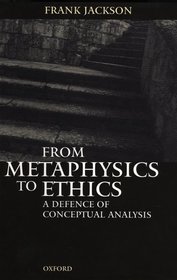
From Metaphysics to Ethics
A Defence of Conceptual Analysis
- Publisher's listprice GBP 127.50
-
57 566 Ft (54 825 Ft + 5% VAT)
The price is estimated because at the time of ordering we do not know what conversion rates will apply to HUF / product currency when the book arrives. In case HUF is weaker, the price increases slightly, in case HUF is stronger, the price goes lower slightly.
- Discount 10% (cc. 5 757 Ft off)
- Discounted price 51 810 Ft (49 343 Ft + 5% VAT)
Subcribe now and take benefit of a favourable price.
Subscribe
57 566 Ft

Availability
printed on demand
Why don't you give exact delivery time?
Delivery time is estimated on our previous experiences. We give estimations only, because we order from outside Hungary, and the delivery time mainly depends on how quickly the publisher supplies the book. Faster or slower deliveries both happen, but we do our best to supply as quickly as possible.
Product details:
- Publisher Clarendon Press
- Date of Publication 8 January 1998
- ISBN 9780198236184
- Binding Hardback
- No. of pages188 pages
- Size 224x144x16 mm
- Weight 357 g
- Language English 0
Categories
Short description:
Frank Jackson champions the cause of conceptual analysis as central to philosophical inquiry. In recent years conceptual analysis has been undervalued and, Jackson suggests, widely misunderstood; he argues that there is nothing especially mysterious about it and a whole range of important questions cannot be productively addressed without it. He anchors his argument in discussion of specific philosophical issues, starting with the metaphysical doctrine of physicalism and moving on, via free will, meaning, personal identity, motion and change, to the philosophy of colour and to ethics. In this way the book not only offers a methodological programme for philosophy, but also throws fascinating new light on some much-debated problems and their interrelations.
MoreLong description:
Frank Jackson champions the cause of conceptual analysis as central to philosophical inquiry. In recent years conceptual analysis has been undervalued and, Jackson suggests, widely misunderstood; he argues that there is nothing especially mysterious about it and a whole range of important questions cannot be productively addressed without it. He anchors his argument in discussion of specific philosophical issues, starting with the metaphysical doctrine of physicalism and moving on, via free will, meaning, personal identity, motion and change, to the philosophy of colour and to ethics. The significance of different kinds of supervenience theses, Kripke and Putnam's work in the philosophy of modality and language, and the role of intuitions about possible cases receive detailed attention. Jackson concludes with a defence of a version of analytical descriptivism in ethics. In this way the book not only offers a methodological programme for philosophy, but also throws fascinating new light on some much-debated problems and their interrelations.
puffs which may be quoted (please do not edit without consulting OUP editor):
'This is an outstanding book. It covers a vast amount of philosophy in a very short space, advances a number of original and striking positions, and manages to be both clear and concise in its expositions of other views and forceful in its criticisms of them. The book offers something new for those interested in the various individual problems it discusses--conceptual analysis, the mind-body relation, secondary qualities, modality, and ethical realism. But unifying these individual discussions is an ambitious structure which amounts to an outline of a complete metaphysical system, and an outline of an epistemology for this metaphysics. It is hard to think of a central area of analytic philosophy which will not be touched by Jackson's conclusions.' Tim Crane, Reader in Philosophy, University College London
'The writing is clear, straightforward, and down to earth--the usual virtues one expects from Jackson . . . what he has to say is innovative and valuable . . . the book deals with a large number of apparently diverse philosophical issues, but it is also an elegantly unified work. What gives it unity is the metaphilosophical framework that Jackson works out with great care and persuasiveness. This is the first serious and sustained work on the methodology of metaphysics in recent memory. What he says about the role of conceptual analysis in metaphysics is an important and timely contribution. . . . It is refreshing and heartening to see a first-class analytic philosopher doing some serious metaphilosophical work . . . I think that the book will be greeted as an important event in philosophical publishing.' Jaegwon Kim, Professor of Philosophy, Brown University
This book is the published version of Jackson's 1995 John Locke Lectures. It is an outstanding work. Given its breath and originality, it deserves to be widely studied. Given its brevity and clarity, it actually might be. The book covers a vast range of topics, from the issue of physicalism in the philosophy of mind, via the nature of conceptual analysis, to the metaphysics of colour and ethics. In each area Jackson stakes out a distinctive position which accords with the basic account of metaphysics defended throughout.
Table of Contents:
Serious metaphysics and supervenience
The role of conceptual analysis
Conceptual analysis and metaphysical necessity
The primary-quality view of colour
The location problem for ethics: moral properties and moral content
Analytical descriptivism
Bibliography
Index

