

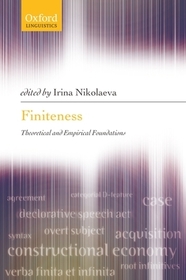
Finiteness
Theoretical and Empirical Foundations
- Publisher's listprice GBP 66.00
-
29 799 Ft (28 380 Ft + 5% VAT)
The price is estimated because at the time of ordering we do not know what conversion rates will apply to HUF / product currency when the book arrives. In case HUF is weaker, the price increases slightly, in case HUF is stronger, the price goes lower slightly.
- Discount 10% (cc. 2 980 Ft off)
- Discounted price 26 819 Ft (25 542 Ft + 5% VAT)
Subcribe now and take benefit of a favourable price.
Subscribe
29 799 Ft

Availability
printed on demand
Why don't you give exact delivery time?
Delivery time is estimated on our previous experiences. We give estimations only, because we order from outside Hungary, and the delivery time mainly depends on how quickly the publisher supplies the book. Faster or slower deliveries both happen, but we do our best to supply as quickly as possible.
Product details:
- Publisher OUP Oxford
- Date of Publication 5 April 2007
- ISBN 9780199213740
- Binding Paperback
- No. of pages552 pages
- Size 235x157x30 mm
- Weight 828 g
- Language English
- Illustrations Tree diagrams, tables and figures 0
Categories
Short description:
This book explores the nature of finiteness, clarifying what it is and establishing its usefulness and limitations. Leading scholars look from a range of perspectives at how finiteness is conceived in formal and functional theories of grammar; at its cross-linguistic manifestations; at the finite/nonfinite opposition in individual languages; and at the role of finiteness in linguistic change and linguistic development. The book is written and structured to appeal to scholars and students of syntax and general linguistics at graduate level and above.
MoreLong description:
This book explores the nature of finiteness, one of most commonly used notions in descriptive and theoretical linguistics but possibly one of the least understood. Scholars representing a variety of theoretical positions seek to clarify what it is and to establish its usefulness and limitations. In doing so they reveal cross-linguistically valid correlations between subject licensing, subject agreement, tense, syntactic opacity, and independent clausehood; show how these properties are associated with finiteness; and discuss what this means for the content of the category. The issues explored include how different grammatical theories represent finiteness; whether the finite/nonfinite distinction is universal; whether there are degrees of finiteness; whether the syntactic notion of finiteness has a semantic corollary; whether and how finiteness is subject to change; and how finiteness features in language acquisition.
Irina Nikolaeva opens the book by describing the history of finiteness and its place in current thinking and research. She then introduces the chapters of the book, comparing the authors' perspectives and showing what they have in common. The book is then divided into four parts. Part I considers the role finiteness plays in formal syntactic theories and Part II its deployment in functional theories and as the subject of research in typology. Parts III and IV look respectively at the finite/nonfinite opposition in individual languages and at the role finiteness plays in linguistic change and linguistic development. The book is written and structured to appeal to scholars and students of syntax and general linguistics at graduate level and above.
The book's value lies in the fact that it broadens our perspective on finiteness by providing ample discussion of 'exceptional' configurations, such as non-finite forms used in independent clauses or inflected infinitives.
Table of Contents:
Introduction
Part I Finiteness in Formal Theories
Three Domains of Finiteness: A Minimalist Perspective
Finiteness in Non-Transformational Syntactic Frameworks
Part II Finiteness in Functional Theories and Typology
Deconstructing Finiteness: Finiteness in a Functional-Typological Perspective
Categories That Make Finiteness: Discreteness From a Functional Perspective and Some of its Repercussions
Constructional Economy and Nonfinite Independent Clauses
Part III Finiteness in Individual Languages
Clausse Structure and Verbal Forms in Nakh-Daghestanian Languages
In What Ways can Finite and Non-Finite Clauses Differ? Evidence from Russian
Verbal and Nominalised Finite Clauses in Turkish
Part IV Finiteness in Diachrony and Language Acquisition
Diachrony and Finiteness: Subordination in the Dialects of Southern Italy
Insubordination and its uses
Finiteness in L1 and L2 Acquisition
References
Subject Index
Author Index

