

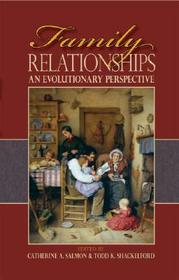
Family Relationships
An evolutionary perspective
- Publisher's listprice GBP 58.00
-
26 187 Ft (24 940 Ft + 5% VAT)
The price is estimated because at the time of ordering we do not know what conversion rates will apply to HUF / product currency when the book arrives. In case HUF is weaker, the price increases slightly, in case HUF is stronger, the price goes lower slightly.
- Discount 10% (cc. 2 619 Ft off)
- Discounted price 23 568 Ft (22 446 Ft + 5% VAT)
Subcribe now and take benefit of a favourable price.
Subscribe
26 187 Ft

Availability
printed on demand
Why don't you give exact delivery time?
Delivery time is estimated on our previous experiences. We give estimations only, because we order from outside Hungary, and the delivery time mainly depends on how quickly the publisher supplies the book. Faster or slower deliveries both happen, but we do our best to supply as quickly as possible.
Product details:
- Publisher OUP USA
- Date of Publication 20 September 2007
- ISBN 9780195320510
- Binding Hardback
- No. of pages376 pages
- Size 160x236x25 mm
- Weight 680 g
- Language English
- Illustrations 6 illustrations 0
Categories
Short description:
In this volume, leading researchers illustrate the ways in which an evolutionary perspective can inform our understanding of family relationships. Humans have evolved specialised mechanisms for processing information and motivating behaviour to deal with the demands of being a mate, parent, sibling, child, or grandparent.
MoreLong description:
Kinship ties - the close relationships found within the family - have been a central focus of evolutionary biological analyses of social behaviour ever since biologist William Hamilton extended the concept of Darwinian fitness to include an individual's actions benefiting not only his own offspring, but also collateral kin. Evolutionary biologists consider not only organisms' reproductive strategists, but also nepotistic strategists. If a person's genes are just as likely to be reproduced in her sister as in her daughter, then we should expect the evolution of sororal investment in the same way as one expects maternal investment. This concept has revolutionized biologists' understanding of social interaction and developmental psychologists' understanding of the family. However, kinship ties have largely been ignored in other areas of psychology, particularly social psychology.
Family Relationships brings together leading theorists and researchers from evolutionary psychology and related disciplines to illustrate the ways in which an evolutionary perspective can inform our study and understanding of family relationships. The contributors argue that family psychology is relationship specific: the relationship between mother and daughter is different from that between father and daughter or that between brother and sister or sister and sister. In other words, humans have evolved specialized mechanisms for processing information and motivating behavior that deal with the distinct demands of being a mate, father, mother, sibling, child, or grandparent. Such an evolutionary perspective on family dynamics provides a unique insight into human behaviour.
Table of Contents:
Part I. Introduction and Overview
Toward an evolutionary psychology of the family
Evolution of the human family: Cooperative males, long social childhoods, smart mothers, and extended kin networks
Evolutionary context of human development: The cooperative breeding model
Part II. Parent-Child Relationships
Life transitions: Becoming a parent
Maternal investment
Evolution of fatherhood
Parent-offspring conflict
Birth order
Part III: Other Family Relationships
Evolutionary perspectives on sibling relationships
Kin detection and the development of sexual aversions: Towards an integration of theories on family sexual abuse
Grandparental and extended kin relationships
Part IV. Applications to Specific Issues
Violence and abuse in families: The consequences of paternal uncertainty
Temperament as a Biological Mechanism for Mate Choice: A hypothesis and preliminary data
Twin research: Evolutionary perspective on social relations
Part V: Conclusions and Future Directions
All in the family: An evolutionary developmental perspective

