

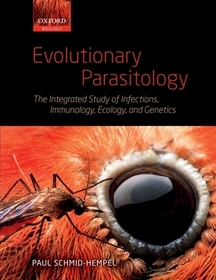
Evolutionary Parasitology
The Integrated Study of Infections, Immunology, Ecology, and Genetics
Series: Oxford Biology;
- Publisher's listprice GBP 49.49
-
22 344 Ft (21 280 Ft + 5% VAT)
The price is estimated because at the time of ordering we do not know what conversion rates will apply to HUF / product currency when the book arrives. In case HUF is weaker, the price increases slightly, in case HUF is stronger, the price goes lower slightly.
- Discount 10% (cc. 2 234 Ft off)
- Discounted price 20 110 Ft (19 152 Ft + 5% VAT)
Subcribe now and take benefit of a favourable price.
Subscribe
22 344 Ft

Availability
Uncertain availability. Please turn to our customer service.
Why don't you give exact delivery time?
Delivery time is estimated on our previous experiences. We give estimations only, because we order from outside Hungary, and the delivery time mainly depends on how quickly the publisher supplies the book. Faster or slower deliveries both happen, but we do our best to supply as quickly as possible.
Product details:
- Publisher Oxford University Press
- Date of Publication 3 March 2011
- ISBN 9780199229499
- Binding Paperback
- No. of pages544 pages
- Size 245x183x27 mm
- Weight 1166 g
- Language English
- Illustrations w. ills. 0
Categories
Short description:
Parasites are among the most serious threats for any organism. This book brings together the latest knowledge from different fields and traces the basic ecological and evolutionary principles behind the eternal and momentous struggle between hosts and their parasites, providing a synthesis of current understanding.
MoreLong description:
Parasites are everywhere, affecting almost every aspect imaginable in the life of their hosts including physiology, behaviour, life histories and, by implication, the structure of entire ecosystems. To cope with these constant threats, host immune defences have evolved to become one of the most sophisticated natural systems known. Despite this, parasites have found their own ways to overcome defences and exploit their hosts. Consequently, hosts and parasites have
been constantly forced to adapt to one another; sometimes changes have occurred very rapidly, whilst others have taken eons. This evolutionary arms race has had far-reaching consequences for the biology of both parties.
Over the last decade, principles from evolution and ecology have increasingly been applied to the fields of parasitology and immunology in an attempt to foster a common conceptual framework that uses a priori principles to unravel the diversity of host-parasite phenomena. This has led to the emergence of some of the most important, highly successful and inter-disciplinary areas of modern biology - the as yet separated fields of ecological immunology and evolutionary studies of parasitism. This
novel book provides the first comprehensive overview of the many facets of host-parasite interactions, from the molecular bases to adaptive strategies and their ecological and evolutionary consequences. It is informed by the very latest progress in the field. No longer do we view well-adapted
parasites as becoming ultimately harmless. To the contrary, parasite virulence is determined both by the processes that lead to harm and by the evolutionary costs and benefits of this damage. Similarly, parasitism is no longer regarded as being inevitably deleterious; rather it can be a major factor maintaining diversity in populations and communities, selecting for beautiful plumages of birds, or even making us more social.
Evolutionary Parasitology integrates material from a wide range of topics including immunology, genetics, sexual selection, population ecology, behavioural ecology, and evolutionary biology. Graduate students and researchers from different fields and with different backgrounds will find this book a valuable reference to meet their interests and to expand their insights into neighbouring disciplines.
... a wonderful and updated introduction to parasitology, full of fascinating examples and thought-provoking ideas. I think any current researcher in parasitology, or anyone with a slight interest in the field, would undoubtedly benefit from reading at least some of the various topics presented in this book. Alejandra G. Jaramillo, TREE
Table of Contents:
From the contents:
Foreword;
1: Parasites and Humans;
2: The Study of Evolutionary Parasitology;
3: The Diversity and Natural History of Parasites;
4: The Natural History of Defences;
5: Ecological Immunology;
6: Parasites, Immunity, and Sexual Selection;
7: Specificity;
8: Parasite Immune Evasion and Manipulation of Host Phenotype;
9: Infection and Pathogenesis;
10: Host
-Parasite Genetics;
11: Epidemiology;
12: Virulence;
13: Host
-Parasite (Co
-)Evolution;
14: Parasites and Host Ecology;
Glossary;
Immunological Acronyms;
References;
Index

