

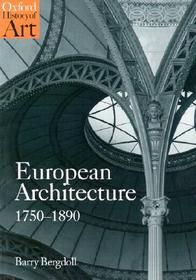
European Architecture 1750-1890
Series: Oxford History of Art;
- Publisher's listprice GBP 24.49
-
11 057 Ft (10 530 Ft + 5% VAT)
The price is estimated because at the time of ordering we do not know what conversion rates will apply to HUF / product currency when the book arrives. In case HUF is weaker, the price increases slightly, in case HUF is stronger, the price goes lower slightly.
- Discount 10% (cc. 1 106 Ft off)
- Discounted price 9 951 Ft (9 477 Ft + 5% VAT)
Subcribe now and take benefit of a favourable price.
Subscribe
11 057 Ft

Availability
printed on demand
Why don't you give exact delivery time?
Delivery time is estimated on our previous experiences. We give estimations only, because we order from outside Hungary, and the delivery time mainly depends on how quickly the publisher supplies the book. Faster or slower deliveries both happen, but we do our best to supply as quickly as possible.
Product details:
- Publisher OUP Oxford
- Date of Publication 14 September 2000
- ISBN 9780192842220
- Binding Paperback
- No. of pages336 pages
- Size 240x167x20 mm
- Weight 786 g
- Language English
- Illustrations colour and black and white halftones throughout 0
Categories
Short description:
A lively thematic survey of eighteenth and nineteenth-century architecture and its extreme diversity within the context of tremendous social, economic and political upheaval. Bergdoll traces key themes the role of changing theories of history in architecture, the impact of scientific methods, and the response to broadening audiences through examples taken from across European architecture. Key developments in architectural history and urban design are related to the most experimental forms that architecture took from Neoclassicism to the Art Nouveau.
MoreLong description:
This comprehensive examination of eighteenth and nineteenth-century architecture explores its extreme diversity within the context of tremendous social, economic and political upheaval. Bergdolls offers a penetrating analysis of the very ways issues of style functioned to make architecture one of the most vitally experimental of art forms in a period of sweeping political, social, and economic change.
Never before had the functional requirements and expressive capacities of architecture been tested so thoroughly and with such diversity of invention. Bergdoll traces this experimentation in a broad range of contexts, focusing in particular on the relation of architectural design to new theories of history, new categories of scientific inquiry, and the broadening audience for architecture in this period of transformation. Unlike traditional surveys with long lists of buildings and architects, the themes are elucidated by in-depth coverage of key buildings which in turn are situated in both their local and European context.
it has an unrivalled consistency of argument ... this book makes a substantial contribution to present knowledge and provides a clear window on the one art form you cannot ignore.
Table of Contents:
Introduction; 1. Neoclassicism: Science, Archaeology and the Doctrine of Progress; 2. What is Enlightenment? The city and the public, 1750-1789; 3. Sensationalism from landscape garden to the architecture of reform, 1750-1800; 4. Revolutionary Architecture; 5. Nationalism and Debates on Architectural Style; 6. Historicism and new building types; 7. New technology and architectural form; 8. The City Transformed; 9. Fin-de-Si?cle; Bibliographical essay; Timeline; Glossary; Index.
More
