

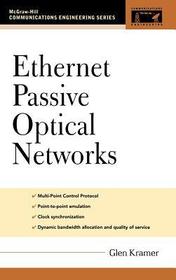
Ethernet Passive Optical Networks
Series: Professional Engineering;
- Publisher's listprice GBP 117.99
-
53 272 Ft (50 735 Ft + 5% VAT)
The price is estimated because at the time of ordering we do not know what conversion rates will apply to HUF / product currency when the book arrives. In case HUF is weaker, the price increases slightly, in case HUF is stronger, the price goes lower slightly.
- Discount 10% (cc. 5 327 Ft off)
- Discounted price 47 945 Ft (45 662 Ft + 5% VAT)
Subcribe now and take benefit of a favourable price.
Subscribe
53 272 Ft

Availability
Estimated delivery time: In stock at the publisher, but not at Prospero's office. Delivery time approx. 3-5 weeks.
Not in stock at Prospero.
Why don't you give exact delivery time?
Delivery time is estimated on our previous experiences. We give estimations only, because we order from outside Hungary, and the delivery time mainly depends on how quickly the publisher supplies the book. Faster or slower deliveries both happen, but we do our best to supply as quickly as possible.
Product details:
- Publisher McGraw Hill
- Date of Publication 16 April 2005
- ISBN 9780071445627
- Binding Hardback
- No. of pages307 pages
- Size 231x149x28 mm
- Weight 611 g
- Language English 0
Categories
Short description:
THE DEFINITIVE GUIDE TO EPON
Written by one of the authors of the IEEE802.3ah standard, this is the first book to fully explain the EPON architecture, analyze its performance, and annotate the standard.
Clearly addressing efficiency, performance, and implementation issues, Ethernet Passive Optical Networks provides valuable, annotated insights into all engineering-critical EPON topics, including:
- PON enabling technologies
- Point-to-point emulation
- Multi-point control protocol
- Error correction
- Performance analysis
- Discovery optimizations
- Quality of service in EPON
- Fairness vs. efficiency
There is no more expert or complete guide to understanding the performance and architectural complexities of EPON than Ethernet Passive Optical Networks.
Inside Ethernet Passive Optical Networks:
Part I: Overview of Access Network Architectures * Introduction * Overview of PON Enabling Technologies * Access Network Architectures Based on TDMA PON * Emergence of Ethernet PON Part II: EPON Architecture* EPON Overview * Logical Topology Emulation * Laser Control Function * Multi-Point Control Protocol: A Formal Specification * Forward Error CorrectionPart III: System-Level Issues * EPON Encryption Mechanism * Path Protection in EPON Part IV: EPON Performance Baseline Efficiency * Discovery Slot Allocation * EPON with Static Slot Assignment * EPON with Dynamic Slot Assignment * Support for Differentiated Classes of Service * Objectives of EPON Scheduling Algorithm * Cousin-Fair Hierarchical Scheduling in EPON * Conclusion
MoreLong description:
Publisher's Note: Products purchased from Third Party sellers are not guaranteed by the publisher for quality, authenticity, or access to any online entitlements included with the product.
THE DEFINITIVE GUIDE TO EPON
Written by one of the authors of the IEEE802.3ah standard, this is the first book to fully explain the EPON architecture, analyze its performance, and annotate the standard.
Clearly addressing efficiency, performance, and implementation issues, Ethernet Passive Optical Networks provides valuable, annotated insights into all engineering-critical EPON topics, including:
- PON enabling technologies
- Point-to-point emulation
- Multi-point control protocol
- Error correction
- Performance analysis
- Discovery optimizations
- Quality of service in EPON
- Fairness vs. efficiency
There is no more expert or complete guide to understanding the performance and architectural complexities of EPON than Ethernet Passive Optical Networks.
Inside Ethernet Passive Optical Networks:
Part I: Overview of Access Network Architectures * Introduction * Overview of PON Enabling Technologies * Access Network Architectures Based on TDMA PON * Emergence of Ethernet PON Part II: EPON Architecture* EPON Overview * Logical Topology Emulation * Laser Control Function * Multi-Point Control Protocol: A Formal Specification * Forward Error CorrectionPart III: System-Level Issues * EPON Encryption Mechanism * Path Protection in EPON Part IV: EPON Performance Baseline Efficiency * Discovery Slot Allocation * EPON with Static Slot Assignment * EPON with Dynamic Slot Assignment * Support for Differentiated Classes of Service * Objectives of EPON Scheduling Algorithm * Cousin-Fair Hierarchical Scheduling in EPON * Conclusion
Publisher's Note: Products purchased from Third Party sellers are not guaranteed by the publisher for quality, authenticity, or access to any online entitlements included with the product.
THE DEFINITIVE GUIDE TO EPON
Written by one of the authors of the IEEE802.3ah standard, this is the first book to fully explain the EPON architecture, analyze its performance, and annotate the standard.
Clearly addressing efficiency, performance, and implementation issues, Ethernet Passive Optical Networks provides valuable, annotated insights into all engineering-critical EPON topics, including:
- PON enabling technologies
- Point-to-point emulation
- Multi-point control protocol
- Error correction
- Performance analysis
- Discovery optimizations
- Quality of service in EPON
- Fairness vs. efficiency
There is no more expert or complete guide to understanding the performance and architectural complexities of EPON than Ethernet Passive Optical Networks.
Inside Ethernet Passive Optical Networks:
Part I: Overview of Access Network Architectures * Introduction * Overview of PON Enabling Technologies * Access Network Architectures Based on TDMA PON * Emergence of Ethernet PON Part II: EPON Architecture* EPON Overview * Logical Topology Emulation * Laser Control Function * Multi-Point Control Protocol: A Formal Specification * Forward Error CorrectionPart III: System-Level Issues * EPON Encryption Mechanism * Path Protection in EPON Part IV: EPON Performance Baseline Efficiency * Discovery Slot Allocation * EPON with Static Slot Assignment * EPON with Dynamic Slot Assignment * Support for Differentiated Classes of Service * Objectives of EPON Scheduling Algorithm * Cousin-Fair Hierarchical Scheduling in EPON * Conclusion
More
