

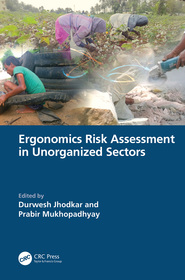
Ergonomics Risk Assessment in Unorganized Sectors
- Publisher's listprice GBP 72.99
-
32 954 Ft (31 385 Ft + 5% VAT)
The price is estimated because at the time of ordering we do not know what conversion rates will apply to HUF / product currency when the book arrives. In case HUF is weaker, the price increases slightly, in case HUF is stronger, the price goes lower slightly.
- Discount 20% (cc. 6 591 Ft off)
- Discounted price 26 363 Ft (25 108 Ft + 5% VAT)
- Discount is valid until: 30 June 2026
Subcribe now and take benefit of a favourable price.
Subscribe
29 659 Ft

Availability
Not yet published.
Why don't you give exact delivery time?
Delivery time is estimated on our previous experiences. We give estimations only, because we order from outside Hungary, and the delivery time mainly depends on how quickly the publisher supplies the book. Faster or slower deliveries both happen, but we do our best to supply as quickly as possible.
Product details:
- Edition number 1
- Publisher CRC Press
- Date of Publication 29 May 2026
- ISBN 9781032934006
- Binding Hardback
- No. of pages154 pages
- Size 234x156 mm
- Language English
- Illustrations 62 Illustrations, black & white; 47 Halftones, black & white; 15 Line drawings, black & white; 14 Tables, black & white 700
Categories
Short description:
The unorganized sector—encompassing agriculture, construction, small-scale manufacturing, healthcare, vending, and service-oriented workforces—remains the backbone of many economies worldwide.
More
Long description:
The unorganized sector—encompassing agriculture, construction, small-scale manufacturing, healthcare, vending, and service-oriented workforces—remains the backbone of many economies worldwide. Yet, workers in this sector often operate in hazardous conditions with little or no social security, occupational safety measures, or ergonomic considerations. Repetitive tasks, awkward postures, poorly designed tools, and physically demanding work contribute to a high prevalence of work-related musculoskeletal disorders (WMSDs) and other health risks.
Ergonomics Risk Assessment in Unorganized Sectors is a comprehensive volume that sheds light on these pressing issues and presents practical solutions. It combines theoretical frameworks, research-based methodologies, and real-world case studies to offer a balanced and applied perspective.
This book:
· Explores the challenges of ergonomics in unorganized sectors across agriculture, manufacturing, healthcare, construction, and service industries.
· Introduces and applies methodologies such as RULA, REBA, and other postural risk evaluation techniques.
· Includes case studies ranging from ergonomic analyses of cotton harvesting and forklift operation to healthcare tasks, cricket postures, and hawker workforces and practices from India, Indonesia, and beyond to illustrate cross-cultural dimensions of ergonomics
· Highlights causes, impacts, and innovative preventive measures against musculoskeletal disorders.
· Addresses the ergonomic risks faced by women in workplaces and their unique occupational health concerns and discusses innovative ergonomic interventions, workplace design improvements, and policy recommendations to enhance worker safety and productivity.
This book serves as a vital resource for students, researchers, ergonomists, industrial engineers, healthcare professionals, and policymakers.
More
Table of Contents:
Part 1: Introduction: Decoding Ergonomic Challenges in Unorganized Sectors. 1. Emerging Trends in Ergonomics for Unorganized Sectors. 2. Evolution of Occupational Hazards and Health Risks. 3. Integrating Anthropometry into Assessment Practices. 4. Physical Strain. Part 2: Ergonomic Risk Assessment Methodologies. 5. Importance of Anatomy and Physiology in Risk Assessment. 6. Innovative Approaches for Ergonomic Assessment Methods. 7. The Role of Technology in Biomechanical Modeling and Analysis. 8. Quantitative Risk Assessment Techniques. 9. Textile and Garment Work: The Seams of Discomfort. 10. Street Vendors and Hawkers. 11. Construction Sites. 12. Agriculture and Farming. 13. Case Study. 14. Case Studies on Ergonomic Challenges Faced by Women Workers. 15. Musculoskeletal Challenges in Unorganized Manufacturing.
More
