

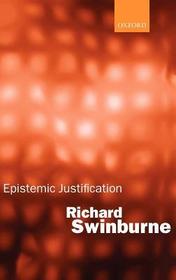
Epistemic Justification
- Publisher's listprice GBP 52.00
-
23 478 Ft (22 360 Ft + 5% VAT)
The price is estimated because at the time of ordering we do not know what conversion rates will apply to HUF / product currency when the book arrives. In case HUF is weaker, the price increases slightly, in case HUF is stronger, the price goes lower slightly.
- Discount 10% (cc. 2 348 Ft off)
- Discounted price 21 130 Ft (20 124 Ft + 5% VAT)
Subcribe now and take benefit of a favourable price.
Subscribe
23 478 Ft

Availability
printed on demand
Why don't you give exact delivery time?
Delivery time is estimated on our previous experiences. We give estimations only, because we order from outside Hungary, and the delivery time mainly depends on how quickly the publisher supplies the book. Faster or slower deliveries both happen, but we do our best to supply as quickly as possible.
Product details:
- Publisher OUP Oxford
- Date of Publication 21 June 2001
- ISBN 9780199243785
- Binding Hardback
- No. of pages270 pages
- Size 243x164x20 mm
- Weight 535 g
- Language English 0
Categories
Short description:
Richard Swinburne offers an original treatment of a question at the heart of epistemology: what makes a belief a rational one, or one which the believer is justified in holding? He maps the many different accounts of epistemic justification, and distinguishes the different kinds of justification that they identify. He argues that while most kinds of justification are worth having, only one kind --internalist justification -- can guide a believer's actions. And he shows how probability theory can illuminate the role of empirical evidence in the justification of belief.
MoreLong description:
Richard Swinburne offers an original treatment of a question at the heart of epistemology: what makes a belief a rational one, or one which the believer is justified in holding? He maps the various totally different and purportedly rival accounts that philosophers give of epistemic justification ('internalist' and 'externalist'), and argues that they are really accounts of different concepts. He distinguishes (as most epistemologists do not) between synchronic justification (justification at a time) and diachronic justification (synchronic justification resulting from adequate investigation) -- both internalist and externalist. He argus that most kinds of justification are worth having because (for different reasons) indicative of truth. However, it is only justification of intermalist kinds that can guide a believer's actions. Swinburne goes on to show the usefulness of the probability calculus in elucidating how empirical evidence makes beliefs probably true: every proposition has an intrinsic probability (an a priori probability independent of empirical evidence) which may be increased or decreased by empirical evidence.
This innovative and challenging book will refresh epistemology and rewrite its agenda.
Readers of Swinburne's rewarding book will get a glimpse from the inside of how a sophisticated doxastic foundationalist understands epistemic justification ... careful and meticulous exposition.
Table of Contents:
Introduction
Theory of Synchronic Justification
Belief
Probability
The Criteria of Logical Probability
Basicality
The Value of Synchronic Justification
The Value of Diachronic Justification
Knowledge
Appendix: Predictivism, Additional Notes, Index

