

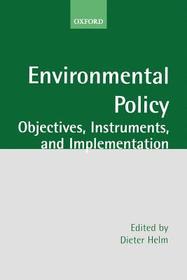
Environmental Policy
Objectives, Instruments, and Implementation
- Publisher's listprice GBP 45.99
-
20 764 Ft (19 775 Ft + 5% VAT)
The price is estimated because at the time of ordering we do not know what conversion rates will apply to HUF / product currency when the book arrives. In case HUF is weaker, the price increases slightly, in case HUF is stronger, the price goes lower slightly.
- Discount 10% (cc. 2 076 Ft off)
- Discounted price 18 687 Ft (17 798 Ft + 5% VAT)
Subcribe now and take benefit of a favourable price.
Subscribe
20 764 Ft

Availability
printed on demand
Why don't you give exact delivery time?
Delivery time is estimated on our previous experiences. We give estimations only, because we order from outside Hungary, and the delivery time mainly depends on how quickly the publisher supplies the book. Faster or slower deliveries both happen, but we do our best to supply as quickly as possible.
Product details:
- Publisher OUP Oxford
- Date of Publication 30 November 2000
- ISBN 9780199241361
- Binding Paperback
- No. of pages342 pages
- Size 235x156x18 mm
- Weight 522 g
- Language English
- Illustrations figures, tables 0
Categories
Short description:
This volume addresses the practical issues which arise in applying economic instruments to environmental policy. It surveys the main concepts and tools?such as sustainability, biodiversity, and costbenefit analysis?and analyses the broad environmental policy agenda, including the global agreements on climate change and the narrow British context. The main sectors of the economy are surveyed, with particular attention paid to transport and agriculture.
MoreLong description:
The twentieth century witnessed unparalleled economic growth among developed countries, largely based upon the exploitation of fossil fuels, and unparalleled population growth in developing countries. These broad trends in turn did massive damage to the environment. Biodiversity has suffered its biggest reverse since the last great extinctions in geological time, and the burning of fossil fuels has begun to change our climate.
But it was only at the end of the century that environmental concerns were transformed from a narrow sectional interest, moving to the centre-stage of government, and on to the main agendas of companies. Once a minority interest, the environment now commands the attention of ministers, chief executives, and consumers in the supermarket. Party manifestos proclaim the greenness of politicians, companies produce environmental reports, and shoppers opt for organic food and avoid genetically modified products.
This volume focuses on the practical design of economic instruments for environmental policy. It is divided into three parts: the overarching policy context; the choice of policy instruments; and applications to the main sectors of the economy.

