

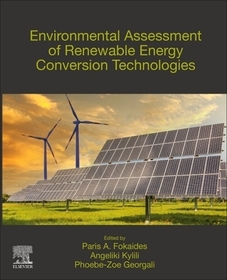
Environmental Assessment of Renewable Energy Conversion Technologies
- Publisher's listprice EUR 131.00
-
51 168 Ft (48 732 Ft + 5% VAT)
The price is estimated because at the time of ordering we do not know what conversion rates will apply to HUF / product currency when the book arrives. In case HUF is weaker, the price increases slightly, in case HUF is stronger, the price goes lower slightly.
- Discount 20% (cc. 10 234 Ft off)
- Discounted price 40 935 Ft (38 986 Ft + 5% VAT)
- Discount is valid until: 30 June 2026
Subcribe now and take benefit of a favourable price.
Subscribe
51 168 Ft

Availability
printed on demand
Why don't you give exact delivery time?
Delivery time is estimated on our previous experiences. We give estimations only, because we order from outside Hungary, and the delivery time mainly depends on how quickly the publisher supplies the book. Faster or slower deliveries both happen, but we do our best to supply as quickly as possible.
Product details:
- Publisher Elsevier Science
- Date of Publication 20 June 2022
- ISBN 9780128171110
- Binding Paperback
- No. of pages330 pages
- Size 228x152 mm
- Weight 450 g
- Language English
- Illustrations Approx. 200 illustrations 214
Categories
Long description:
Environmental Assessment of Renewable Energy Conversion Technologies provides state-of-the-art coverage in both non-fossil energy conversion and storage techniques, as well as in their environmental assessment. This includes goal and scope, analysis boundaries,- inventory and the impact assessment employed for the evaluation of these applications, as well as the environmental footprint of the technologies. The book compiles information currently available only in different sources concerning the environmental assessment of sustainable energy technologies, allowing for the comparative assessments of different technologies given specific boundary conditions, such as renewable potential and other specific features of discussed technologies.
It offers readers a comprehensive overview of the entire energy supply chain, namely from production to storage, by allowing the consideration of different production and storage combinations, based on their environmental assessment.
MoreTable of Contents:
Part A: Introduction
1. State-of-the-art in Environmental Assessment Techniques
2. European and Global Legislative Framework of Energy Technologies Environmental Assessment
Part B: Environmental Assessment of Renewable Energy Conversion Technologies
3. Solar Energy - PV
4. Solar Energy - Low-Heat Solar Thermal Applications (for heating)
5. Solar Energy - High Temperature Solar Thermal Applications (CSPs) (for power)
6. Wind Technologies - Wind Turbines
7. Biomass to Biofuels - Thermochemical Conversion Routes (Torrefaction, Pyrolysis, Gasification)
8. Biomass to Biofuels - Biochemical Conversion Routes (Anaerobic Digestion, Fermentation)
9. Biomass to Biofuels - Mechanical Conversion Routes (Pelleting, Briquetting)
10. Geothermal Energy - Shallow Geothermal Applications (for heating)
11. Geothermal Energy - High Enthalpy Geothermal Applications (for power)
12. Hydro Energy - Hydropower stations
13. Hydro Energy - Tidal Power
14. Water to Hydrogen Conversion Routes
Part C: Environmental Assessment of Renewable Energy Storage Technologies
15. Heat Storage (Heat Capacity, Latent Heat)
16. Pumped Hydrostorage
17. Compressed Gas Storage
18. Battery Storage
Part D: Comparative Environmental Assessment of Renewable Energy Conversion and Storage Techniques
19. Environmental Assessment of Renewable Energy Conversion Techniques
20. Environmental Assessment of Renewable Energy Storage Techniques

