

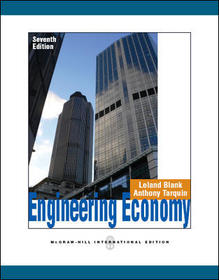
Engineering Economy
Series: Asia Higher Education Engineering/Computer Science Industrial Engineering;
- Publisher's listprice GBP 55.99
-
25 279 Ft (24 075 Ft + 5% VAT)
The price is estimated because at the time of ordering we do not know what conversion rates will apply to HUF / product currency when the book arrives. In case HUF is weaker, the price increases slightly, in case HUF is stronger, the price goes lower slightly.
- Discount 10% (cc. 2 528 Ft off)
- Discounted price 22 751 Ft (21 668 Ft + 5% VAT)
Subcribe now and take benefit of a favourable price.
Subscribe
25 279 Ft

Availability
Out of print
Why don't you give exact delivery time?
Delivery time is estimated on our previous experiences. We give estimations only, because we order from outside Hungary, and the delivery time mainly depends on how quickly the publisher supplies the book. Faster or slower deliveries both happen, but we do our best to supply as quickly as possible.
Product details:
- Edition number 7
- Publisher McGraw-Hill
- Date of Publication 16 May 2011
- ISBN 9780071086097
- Binding Paperback
- No. of pages0 pages
- Size 277x220x23 mm
- Weight 1 g
- Language English 0
Categories
Long description:
Engineering Economy, 7th edition, presents a crisp, bold new design using color, highlighting and icons to focus on important concepts, terms, equations and decision guidelines. There are new features, new topics (such as ethics and staged decision making), and new online tools; yet no compromise on coverage, examples, or the well-accepted writing style of this popular text. The preface provides an overview of What's New and graphically depicts resources for Instructors and Students. Solved examples, problems and case studies target many of the current engineering challenges in areas such as energy, ethics, the environment, and the world's changing economics. Approximately eighty percent of the end-of-chapter problems are revised or new for this edition.
Some of the outstanding pedagogical characteristics of this new edition include its easy-to-read writing style, learning outcomes for each section, progressive examples used throughout a chapter, solved examples using manual and integrated spreadsheet solutions, updated case studies, Fundamentals of Engineering (FE) exam questions for each chapter, and numerous new end-of-chapter exercises.
A significant new feature is the availability of brief, downloadable online presentations (podcasts) that incorporate voice-over, animated Power Point slides. These are available on the text's website for students and instructors to utilize as support tools in or outside the classroom. Each module includes descriptive material and worked examples that supplement course material.
Engineering Economy, 7th edition, presents a crisp, bold new design using color, highlighting and icons to focus on important concepts, terms, equations and decision guidelines. There are new features, new topics (such as ethics and staged decision making), and new online tools; yet no compromise on coverage, examples, or the well-accepted writing style of this popular text. The preface provides an overview of What's New and graphically depicts resources for Instructors and Students. Solved examples, problems and case studies target many of the current engineering challenges in areas such as energy, ethics, the environment, and the world's changing economics. Approximately eighty percent of the end-of-chapter problems are revised or new for this edition.
Some of the outstanding pedagogical characteristics of this new edition include its easy-to-read writing style, learning outcomes for each section, progressive examples used throughout a chapter, solved examples using manual and integrated spreadsheet solutions, updated case studies, Fundamentals of Engineering (FE) exam questions for each chapter, and numerous new end-of-chapter exercises.
A significant new feature is the availability of brief, downloadable online presentations (podcasts) that incorporate voice-over, animated Power Point slides. These are available on the text's website for students and instructors to utilize as support tools in or outside the classroom. Each module includes descriptive material and worked examples that supplement course material.
More
