

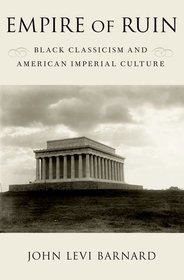
Empire of Ruin
Black Classicism and American Imperial Culture
- Publisher's listprice GBP 29.99
-
13 540 Ft (12 895 Ft + 5% VAT)
The price is estimated because at the time of ordering we do not know what conversion rates will apply to HUF / product currency when the book arrives. In case HUF is weaker, the price increases slightly, in case HUF is stronger, the price goes lower slightly.
- Discount 10% (cc. 1 354 Ft off)
- Discounted price 12 186 Ft (11 606 Ft + 5% VAT)
Subcribe now and take benefit of a favourable price.
Subscribe
13 540 Ft

Availability
Only to order.
Why don't you give exact delivery time?
Delivery time is estimated on our previous experiences. We give estimations only, because we order from outside Hungary, and the delivery time mainly depends on how quickly the publisher supplies the book. Faster or slower deliveries both happen, but we do our best to supply as quickly as possible.
Product details:
- Publisher OUP USA
- Date of Publication 1 June 2022
- ISBN 9780197635100
- Binding Paperback
- No. of pages246 pages
- Size 155x239x25 mm
- Weight 503 g
- Language English 192
Categories
Short description:
Empire of Ruin traces the cultural history and reception of the classical tradition in African American cultural production. While the classical tradition has provided a repository of ideas that have allowed white American elites to conceive of the nation as an ideal Republic, Empire of Ruin offers a critical counter-narrative, showing how African American writers, artists, and activists have characterized this as emblematic of a national commitment to an economy of enslavement and a geopolitical project of empire.
MoreLong description:
From the US Capitol to the Lincoln Memorial and the 9/11 Memorial Museum, classical forms and ideas have been central to an American nationalist aesthetic. Beginning with an understanding of this centrality of the classical tradition to the construction of American national identity and the projection of American power, Empire of Ruin describes a mode of black classicism that has been integral to the larger critique of American politics, aesthetics, and historiography that African American cultural production has more generally advanced. While the classical tradition has provided a repository of ideas and images that have allowed white American elites to conceive of the nation as an ideal Republic and the vanguard of the idea of civilization, African American writers, artists, and activists have characterized this dominant mode of classical appropriation as emblematic of a national commitment to an economy of enslavement and a geopolitical project of empire. If the dominant forms of American classicism and monumental culture have asserted the ascendancy of what Thomas Jefferson called an "empire for liberty," for African American writers and artists it has suggested that the nation is nothing exceptional, but rather another iteration of what the radical abolitionist Henry Highland Garnet identified as an "empire of slavery," inexorably devolving into an "empire of ruin."
Honorable Mention for the 2018 MLA William Sanders Scarborough Prize
Table of Contents:
Introduction
Chapter 1: Phillis Wheatley and the Affairs of State
Chapter 2: In Plain Sight: Slavery and the Architecture of Democracy
Chapter 3: Ancient History, American Time: Charles Chesnutt and the Sites of Memory
Chapter 4: Crumbling into Dust: Conjure and the Ruins of Empire
Chapter 5: National Monuments and the Residue of History

