

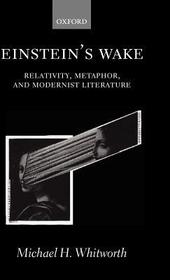
Einstein's Wake
Relativity, Metaphor, and Modernist Literature
- Publisher's listprice GBP 197.50
-
89 171 Ft (84 925 Ft + 5% VAT)
The price is estimated because at the time of ordering we do not know what conversion rates will apply to HUF / product currency when the book arrives. In case HUF is weaker, the price increases slightly, in case HUF is stronger, the price goes lower slightly.
- Discount 10% (cc. 8 917 Ft off)
- Discounted price 80 254 Ft (76 433 Ft + 5% VAT)
Subcribe now and take benefit of a favourable price.
Subscribe
89 171 Ft

Availability
printed on demand
Why don't you give exact delivery time?
Delivery time is estimated on our previous experiences. We give estimations only, because we order from outside Hungary, and the delivery time mainly depends on how quickly the publisher supplies the book. Faster or slower deliveries both happen, but we do our best to supply as quickly as possible.
Product details:
- Publisher OUP Oxford
- Date of Publication 13 December 2001
- ISBN 9780198186403
- Binding Hardback
- No. of pages240 pages
- Size 225x146x19 mm
- Weight 424 g
- Language English 0
Categories
Short description:
Modernist writers were well aware of the new physics and its underlying concepts. Einstein's Wake shows how the most innovative scientific thinking was understood by non-specialists such as Joseph Conrad, Virginia Woolf, D. H. Lawrence, and T. S. Eliot, and how it entered into their literary works.
MoreLong description:
The revolution in literary form and aesthetic consciousness called modernism arose as the physical sciences were revising their most fundamental concepts: space, time, matter, and the concept of 'science' itself. The coincidence has often been remarked upon in general terms, but rarely considered in detail. Einstein's Wake argues that the interaction of modernism and the 'new physics' is best understood by reference to the metaphors which structured these developments. These metaphors, widely disseminated in the popular science writing of the period, provided a language with which modernist writers could articulate their responses to the experience of modernity. Beginning with influential aspects of nineteenth-century physics, Einstein's Wake qualifies the notion that Einstein alone was responsible for literary 'relativity'; it goes on to examine the fine detail of his legacy in literary appropriations of scientific metaphors, with particular attention to Virginia Woolf, D. H. Lawrence, Wyndham Lewis, and T. S. Eliot.
Einstein's Wake is a revealing study and deserves an attentive audience.
Table of Contents:
Introduction
The Specialist, the Generalist, and the Popularist
Things Fall Apart: The Secret Agent and Literary Entropy
Descriptionism: Consuming Sensations
An Entente Cordiale? The New Relations of Literature and Science
Invisible Men and Fractured Atoms
Simultaneity: A Return Ticket to Waterloo
Non-Euclidean Humanity
Conclusion
Select Bibliography
Index

