

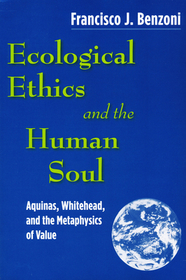
Ecological Ethics and the Human Soul
Aquinas, Whitehead, and the Metaphysics of Value
- Publisher's listprice GBP 26.99
-
12 894 Ft (12 280 Ft + 5% VAT)
The price is estimated because at the time of ordering we do not know what conversion rates will apply to HUF / product currency when the book arrives. In case HUF is weaker, the price increases slightly, in case HUF is stronger, the price goes lower slightly.
- Discount 10% (cc. 1 289 Ft off)
- Discounted price 11 605 Ft (11 052 Ft + 5% VAT)
Subcribe now and take benefit of a favourable price.
Subscribe
12 894 Ft

Availability
Estimated delivery time: In stock at the publisher, but not at Prospero's office. Delivery time approx. 3-5 weeks.
Not in stock at Prospero.
Why don't you give exact delivery time?
Delivery time is estimated on our previous experiences. We give estimations only, because we order from outside Hungary, and the delivery time mainly depends on how quickly the publisher supplies the book. Faster or slower deliveries both happen, but we do our best to supply as quickly as possible.
Product details:
- Publisher University of Notre Dame Press
- Date of Publication 15 January 2008
- Number of Volumes Print PDF
- ISBN 9780268022051
- Binding Paperback
- No. of pages262 pages
- Size 229x152x15 mm
- Weight 372 g
- Language English 0
Categories
Long description:
In Ecological Ethics and the Human Soul: Aquinas, Whitehead, and the Metaphysics of Value, Francisco J. Benzoni addresses the pervasive and destructive view that there is a moral gulf between human beings and other creatures. Thomas Aquinas, whose metaphysics entails such a moral gulf, holds that human beings are ultimately separate from nature. Alfred North Whitehead, in contrast, maintains that human beings are continuous with the rest of nature. These different metaphysical systems demand different ethical stances toward creation.
Benzoni analyzes and challenges Thomas's understanding of the human soul, his primary justification for the moral separation, arguing that it is finally philosophically untenable. The author finds promising the alternative metaphysics of Whitehead, for whom human beings are a part of nature---even if the highest part; all creatures have a degree of subjectivity and creativity, and thus all have intrinsic value and moral worth, independent of subjective human valuation. Further, though there is difference, there is no moral gulf between God and the world. God is truly affected by the experience of creatures. Benzoni argues that if this vision of moral worth is articulated with sufficient force and clarity, it could help heal the human relation to our planet.
More
