

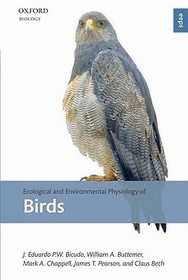
Ecological and Environmental Physiology of Birds
Series: Ecological and Environmental Physiology;
- Publisher's listprice GBP 70.00
-
31 605 Ft (30 100 Ft + 5% VAT)
The price is estimated because at the time of ordering we do not know what conversion rates will apply to HUF / product currency when the book arrives. In case HUF is weaker, the price increases slightly, in case HUF is stronger, the price goes lower slightly.
- Discount 10% (cc. 3 161 Ft off)
- Discounted price 28 445 Ft (27 090 Ft + 5% VAT)
Subcribe now and take benefit of a favourable price.
Subscribe
31 605 Ft

Availability
printed on demand
Why don't you give exact delivery time?
Delivery time is estimated on our previous experiences. We give estimations only, because we order from outside Hungary, and the delivery time mainly depends on how quickly the publisher supplies the book. Faster or slower deliveries both happen, but we do our best to supply as quickly as possible.
Product details:
- Publisher OUP Oxford
- Date of Publication 1 April 2010
- ISBN 9780199228454
- Binding Paperback
- No. of pages335 pages
- Size 234x154x15 mm
- Weight 523 g
- Language English
- Illustrations 60 illustrations 0
Categories
Short description:
This is the first book to examine avian physiology in detail as it relates to the environment. As with other books in the Ecological and Environmental Physiology Series, the emphasis is on the unique physiological characteristics of birds, although experimental techniques and future research directions are also considered.
MoreLong description:
Birds have colonized almost every terrestrial habitat on the planet - from the poles to the tropics, and from deserts to high mountain tops. Ecological and Environmental Physiology of Birds focuses on our current understanding of the unique physiological characteristics of birds that are of particular interest to ornithologists, but also have a wider biological relevance. An introductory chapter covers the basic avian body plan and their still-enigmatic evolutionary history. The focus then shifts to a consideration of the essential components of that most fundamental of avian attributes: the ability to fly. The emphasis here is on feather evolution and development, flight energetics and aerodynamics, migration, and as a counterpoint, the curious secondary evolution of flightlessness that has occurred in several lineages. This sets the stage for subsequent chapters, which present specific physiological topics within a strongly ecological and environmental framework. These include gas exchange, thermal and osmotic balance, 'classical' life history parameters (male and female reproductive costs, parental care and investment in offspring, and fecundity versus longevity tradeoffs), feeding and digestive physiology, adaptations to challenging environments (high altitude, deserts, marine habitats, cold), and neural specializations (notably those important in foraging, long-distance navigation, and song production). Throughout the book classical studies are integrated with the latest research findings. Numerous important and intriguing questions await further work, and the book concludes with a discussion of methods (emphasizing cutting-edge technology), approaches, and future research directions.
MoreTable of Contents:
Introduction - Blueprint of a Bird (Bauplan/Body plan)
General Physiological Principles
Physiological Bases of Fecundity/Longevity Tradeoffs
Adaptations: Obtaining and Processing Food
Adaptations: Living in Specific Environments
Adaptations: Neural and Sensory
Adaptations: Developmental Physiology
Approaches and Techniques
Conclusions and Future Directions
References
Index

