

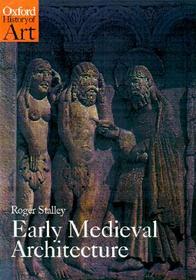
Early Medieval Architecture
Series: Oxford History of Art;
- Publisher's listprice GBP 24.49
-
11 057 Ft (10 530 Ft + 5% VAT)
The price is estimated because at the time of ordering we do not know what conversion rates will apply to HUF / product currency when the book arrives. In case HUF is weaker, the price increases slightly, in case HUF is stronger, the price goes lower slightly.
- Discount 10% (cc. 1 106 Ft off)
- Discounted price 9 951 Ft (9 477 Ft + 5% VAT)
Subcribe now and take benefit of a favourable price.
Subscribe
11 057 Ft

Availability
printed on demand
Why don't you give exact delivery time?
Delivery time is estimated on our previous experiences. We give estimations only, because we order from outside Hungary, and the delivery time mainly depends on how quickly the publisher supplies the book. Faster or slower deliveries both happen, but we do our best to supply as quickly as possible.
Product details:
- Publisher OUP Oxford
- Date of Publication 21 October 1999
- ISBN 9780192842237
- Binding Paperback
- No. of pages274 pages
- Size 240x167x16 mm
- Weight 644 g
- Language English
- Illustrations numerous colour and halftone illustrations, line drawings, 2 maps 0
Categories
Short description:
The early middle ages were an exciting period in the history of European architecture, culminating in the development of the Romanesque style. Major architectural innovations were made during this time including the castle, the church spire, and the monastic cloister. This lucidly-written book expands upon key themes and issues to provide a fresh and radically new approach to the architecture of the period.
MoreLong description:
The early middle ages were an exciting period in the history of European architecture, culminating in the development of the Romanesque style. Major architectural innovations were made during this time including the medieval castle, the church spire, and the monastic cloister. By avoiding the traditional emphasis on chronological development, Roger Stalley provides a radically new approach to the subject, exploring issues and themes rather than sequences and dates. In addition to analysing the language of the Romanesque, the book examines the engineering achievements of the builders, and clearly how the great monuments of the age were designed and constructed. Ranging from Gotland to Apulia, the richness and variety of European architecture is explored in terms of the social and religious aspirations of the time. Symbolic meanings associated with architecture are also thoroughly investigated. Written with style and humour, the lively text includes many quotations from ancient sources, providing a fascinating insight into the way that medieval buildings were created, and in the process enlivening study of this period.
MoreTable of Contents:
Introduction
The Christian basilica
The Carolingian renaissance
Symbolic buildings
Architecture and pilgrimage
Architecture and monasticism
Diversity in the Romanesque era
The language of architecture
Secular architecture in the age of feudalism
Art and engineering
Patron and Builder
Epilogue: the shadow of Rome
Notes; List of Illustrations; Bibliographic Essay; Timeline; Index

