

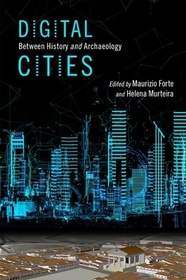
Digital Cities
Between History and Archaeology
- Publisher's listprice GBP 127.50
-
57 566 Ft (54 825 Ft + 5% VAT)
The price is estimated because at the time of ordering we do not know what conversion rates will apply to HUF / product currency when the book arrives. In case HUF is weaker, the price increases slightly, in case HUF is stronger, the price goes lower slightly.
- Discount 20% (cc. 11 513 Ft off)
- Discounted price 46 053 Ft (43 860 Ft + 5% VAT)
- Discount is valid until: 30 June 2026
Subcribe now and take benefit of a favourable price.
Subscribe
57 566 Ft

Availability
Estimated delivery time: In stock at the publisher, but not at Prospero's office. Delivery time approx. 3-5 weeks.
Not in stock at Prospero.
Why don't you give exact delivery time?
Delivery time is estimated on our previous experiences. We give estimations only, because we order from outside Hungary, and the delivery time mainly depends on how quickly the publisher supplies the book. Faster or slower deliveries both happen, but we do our best to supply as quickly as possible.
Product details:
- Publisher OUP USA
- Date of Publication 24 March 2020
- ISBN 9780190498900
- Binding Hardback
- No. of pages342 pages
- Size 160x243x31 mm
- Weight 766 g
- Language English 0
Categories
Short description:
This volume explores the new paradigm of the Digital City as being simultaneously a past and a contemporary entity.
MoreLong description:
The onset of digital archaeology and its subsequent remarkable development has had a crucial impact on the study of cultural heritage. Presently, researchers are able to manipulate and reinvent digital and historical data; the study of the city stands out in this context. Cities are microcosms, often reflecting the changing structure of societies over time. A vast array of digital tools (laser scanning, augmented reality, remote sensing, and beyond) can process, test, and display archaeological data, architectural remains, and built heritage on a scale previously unattainable. The digitization of historical research is manipulating and reinventing the ways in which we examine historical evidence. This intersection between history and computer science allows for an expansion and enhancement of historical, archaeological, and anthropological research. The resulting configurations lead to the creation of new data and new objects of study within these fields, which makes it crucial for those in these fields to understand the impact of generating digital information in this context.
Digital Cities explores the study of the city in the digital realm by reexamining the data processing and knowledge sharing between historians, architects, geographers, anthropologist, and computer scientists. Digital Cities considers the city from pre-historic settlements to the present in different geographical contexts. Each section of the book offers a new level of engagement with various digital tools, spanning topics such as the challenges digital instruments pose to the study of pre-urban and urban contexts, the didactic scope of virtual heritage, and the consolidation of the relationship between digital language and historical narrative. The resulting research traverses the idea of Digital Cities through a historical, social, and multimodal context, and it fills the gap in scholarship between the study of the city and the concept and significance of the Digital City.
Table of Contents:
Introduction Maurizio Forte and Helena Murteira
Part 1 - Methodological challenges
1. Vulci 3000: a Digital Challenge for the Interpretation of Etruscan and Roman Cities Maurizio Forte, Nevio Danelon, David Johnston, Katherine McCusker, Everett Newton, Gianfranco Morelli and Gianluca Catanzariti
2. "I dreamt I dwelt in marble halls": Using Computer Based Visualisation of Roman Domestic Architecture to Evoke the Built and the "Felt" Environment Richard Beacham
3. The Digital Revolution and Modeling Time and Change in Historic Buildings and Cities: The Case of Visualizing Venice Caroline Bruzelius
4. Exploring visually the known and the ill-known about Krak--w's centre urban evolution: an information visualisation perspective Jean-Yves Blaise and Iwona Dudek
5. Experiencing past, present and future urban environments through digital representation, storytelling and simulation Eva Pietroni
6. Simplified Crowd Simulation in Virtual Heritage Sites Lu--s Sequeira
Part 2 - Conservation, requalification and communication
1. At-Risk World Heritage and Virtual Reality Visualization for Cyber-Archaeology - The Mar Saba Test Case Thomas E. Levy, Connor Smith, Kristin Agcaoili, Anish Kannan, Avner Goren, J--rgen P. Schulze, and Glenn Yago
2. Oporto's Historic Centre (WH) - from historical research to (real) Virtual Heritage Visualization Maria Leonor Botelho
3. Omnidirectional Strategies for Exploring Ancient Cities and Territories Sarah Kenderdine
Part 3 - Hermeneutics and epistemological boundaries
1. --atalh--y--k as an Open Site? On the Openness of Virtual Reconstructions of Archaeological Sites to a Multiplicity of Interpretations Zeynep Akt--re
2. Virtual Cities as Memoryscapes: The Case of Lisbon Maria Alexandra Gago da C--mara, Helena Murteira and Paulo Sim--es Rodrigues
Part 4- Research, planning and learning
1. Spatial Representation of Vienna's Street-Level Environment-Urban Parterre Mapping (UPM) Angelika Psenner
2. Unreal Projects: Using Immersive Visualization to Learn about Distant and Historical Locales Gabriela Campagnol, Stephen Caffey, Mark J. Clayton, Kevin Glowacki, Nancy Klein, Julian Kang and Geoffrey Booth
3. At the Interface - Multimodal Sensing and Intelligent Learning Systems -The Dynamic Transformation of the Cityscape, and Its Ongoing Study Bill Seaman

