

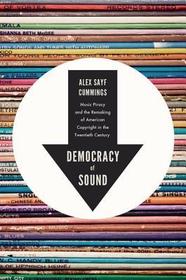
Democracy of Sound
Music Piracy and the Remaking of American Copyright in the Twentieth Century
- Publisher's listprice GBP 43.49
-
19 635 Ft (18 700 Ft + 5% VAT)
The price is estimated because at the time of ordering we do not know what conversion rates will apply to HUF / product currency when the book arrives. In case HUF is weaker, the price increases slightly, in case HUF is stronger, the price goes lower slightly.
- Discount 10% (cc. 1 964 Ft off)
- Discounted price 17 672 Ft (16 830 Ft + 5% VAT)
Subcribe now and take benefit of a favourable price.
Subscribe
19 635 Ft

Availability
printed on demand
Why don't you give exact delivery time?
Delivery time is estimated on our previous experiences. We give estimations only, because we order from outside Hungary, and the delivery time mainly depends on how quickly the publisher supplies the book. Faster or slower deliveries both happen, but we do our best to supply as quickly as possible.
Product details:
- Publisher OUP USA
- Date of Publication 25 April 2013
- ISBN 9780199858224
- Binding Hardback
- No. of pages272 pages
- Size 155x239x27 mm
- Weight 499 g
- Language English
- Illustrations 20 hts 0
Categories
Short description:
Democracy of Sound tells the story of the pirates, radicals, jazzbos, Deadheads, and DJs who challenged the record industry for control of recorded sound throughout the twentieth century. A political and cultural history, it shows how the primacy of "intellectual property" gradually eclipsed an American political tradition that was suspicious of monopolies and favored free competition.
MoreLong description:
Democracy of Sound is the first book to examine music piracy in the United States from the dawn of sound recording to the rise of Napster and online file-sharing. It asks why Americans stopped thinking of copyright as a monopoly-a kind of necessary evil-and came to see intellectual property as sacrosanct and necessary for the prosperity of an "information economy." Recordings only became eligible for federal copyright in 1972, following years of struggle between pirates, musicians, songwriters, broadcasters, and record companies over the right to own sound. Beginning in the 1890s, the book follows the competing visions of Americans who proposed ways to keep obscure and noncommercial music in circulation, preserve out-of-print recordings from extinction, or simply make records more freely and cheaply available. Genteel jazz collectors swapped and copied rare records in the 1930s; radicals pitched piracy as a mortal threat to capitalism in the 1960s, while hip-hop DJs from the 1970s onwards reused and transformed sounds to create a freer and less regulated market for mixtapes. Each challenged the idea that sound could be owned by anyone. The conflict led to the contemporary stalemate between those who believe that "information wants to be free" and those who insist that economic prosperity depends on protecting intellectual property. The saga of piracy also shows how the dubbers, bootleggers, and tape traders forged new social networks that ultimately gave rise to the social media of the twenty first century. Democracy of Sound is a colorful story of people making law, resisting law, and imagining how law might shape the future of music, from the Victrola and pianola to iTunes and BitTorrent.
a jolly good read ... captivating ... packed with excellent historical research that charts music piracy as far back as 1877
Table of Contents:
Introduction
Part One: The Birth and Growth of Piracy, 1877-1955
Ch. 1: Music, Machines, and Monopoly
Ch. 2: Collectors, Con Men, and the Struggle for Property Rights
Ch. 3: Piracy and the Rise of New Media
Part Two: The Legal Backlash, 1945-1998
Ch. 4: Counterculture, Popular Music, and the Bootleg Boom
Ch. 5: The Criminalization of Piracy
Ch. 6: Deadheads, Hip Hop, and the Possibility of Compromise
Ch. 7: The Global War on Piracy
Conclusion: Piracy as Social Media
Notes
Index

