

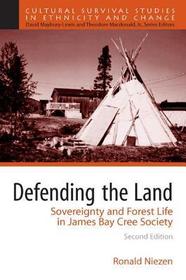
Defending the Land
Sovereignty and Forest Life in James Bay Cree Society
-
GET 10% OFF
- Publisher's listprice GBP 45.99
-
20 764 Ft (19 775 Ft + 5% VAT)
The price is estimated because at the time of ordering we do not know what conversion rates will apply to HUF / product currency when the book arrives. In case HUF is weaker, the price increases slightly, in case HUF is stronger, the price goes lower slightly.
- Discount 10% (cc. 2 076 Ft off)
- Discounted price 18 687 Ft (17 798 Ft + 5% VAT)
18 687 Ft

Availability
Estimated delivery time: In stock at the publisher, but not at Prospero's office. Delivery time approx. 3-5 weeks.
Not in stock at Prospero.
Why don't you give exact delivery time?
Delivery time is estimated on our previous experiences. We give estimations only, because we order from outside Hungary, and the delivery time mainly depends on how quickly the publisher supplies the book. Faster or slower deliveries both happen, but we do our best to supply as quickly as possible.
Product details:
- Edition number 2, New edition
- Publisher Routledge
- Date of Publication 7 August 2008
- ISBN 9780205651085
- Binding Paperback
- No. of pages136 pages
- Size 229x152 mm
- Weight 204 g
- Language English 0
Categories
Short description:
Suitable for both introductory anthropology and upper-division courses in cultural anthropology
The campaign of the Cree people to protect their forest culture from the impact of hydro-electric development in northern Quebec has been widely-documented. Few have heard in any detail about this campaign's outcome and impact upon indigenous societies' futures. This text gives equal attention to the Cree leadership's successful strategies for dealing with major social and environmental pressures with the forces of acculturation and native communities' social destruction.
The titles in the Cultural Survival Studies in Ethnicity and Change series, edited by David Maybury-Lewis and Theodore Macdonald, Jr. of Cultural Survival, Inc., Harvard University, focus on key issues affecting indigenous and ethnic groups worldwide. Each ethnography builds on introductory material by going further in-depth and allowing students to explore, virtually first-hand, a particular issue and its impact on a culture.
Long description:
Suitable for both introductory anthropology and upper-division courses in cultural anthropology
The campaign of the Cree people to protect their forest culture from the impact of hydro-electric development in northern Quebec has been widely-documented. Few have heard in any detail about this campaign's outcome and impact upon indigenous societies' futures. This text gives equal attention to the Cree leadership's successful strategies for dealing with major social and environmental pressures with the forces of acculturation and native communities' social destruction.
The titles in the Cultural Survival Studies in Ethnicity and Change series, edited by David Maybury-Lewis and Theodore Macdonald, Jr. of Cultural Survival, Inc., Harvard University, focus on key issues affecting indigenous and ethnic groups worldwide. Each ethnography builds on introductory material by going further in-depth and allowing students to explore, virtually first-hand, a particular issue and its impact on a culture.
Table of Contents:
Preface to the Series
Preface to the Second Edition
1. Introduction.
2. Living on the Land.
“Ownership” of the Land.
Seasons on the Land.
Forest Spirituality.
Healing.
3. The Origins of a Dual Lifestyle.
The Fur Trade.
Missions, Medicine, and Residential Education.
Federal Intervention.
4. Negotiated Transformations.
Hydro-Electricity and the Goals of Extractive Industry.
The James Bay Agreement.
5. Crisis and Accommodation.
The Social Aftermath.
The Pursuit of Health Care Autonomy.
Redefining Education.
Accommodation.
6. Struggles over Sovereignty.
The James Bay Project Revisited.
Two Sovereignties.
The Spoilers.
7. Conclusion.
8. Epilogue
References

