

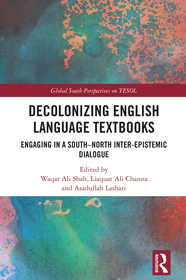
Decolonizing English Language Textbooks
Engaging in a South-North Inter-epistemic Dialogue
Series: Global South Perspectives on TESOL;
- Publisher's listprice GBP 155.00
-
69 982 Ft (66 650 Ft + 5% VAT)
The price is estimated because at the time of ordering we do not know what conversion rates will apply to HUF / product currency when the book arrives. In case HUF is weaker, the price increases slightly, in case HUF is stronger, the price goes lower slightly.
- Discount 20% (cc. 13 996 Ft off)
- Discounted price 55 986 Ft (53 320 Ft + 5% VAT)
- Discount is valid until: 30 June 2026
Subcribe now and take benefit of a favourable price.
Subscribe
62 984 Ft

Availability
Estimated delivery time: In stock at the publisher, but not at Prospero's office. Delivery time approx. 3-5 weeks.
Not in stock at Prospero.
Why don't you give exact delivery time?
Delivery time is estimated on our previous experiences. We give estimations only, because we order from outside Hungary, and the delivery time mainly depends on how quickly the publisher supplies the book. Faster or slower deliveries both happen, but we do our best to supply as quickly as possible.
Product details:
- Edition number 1
- Publisher Routledge
- Date of Publication 31 March 2026
- ISBN 9781041101260
- Binding Hardback
- No. of pages280 pages
- Size 234x156 mm
- Weight 680 g
- Language English
- Illustrations 25 Illustrations, black & white; 25 Halftones, black & white; 16 Tables, black & white 692
Categories
Short description:
Bringing together diverse perspectives from authors situated in both the South and the Global North, this ground-breaking volume takes a critical, decolonial and global southern approach to exploring colonial epistemologies and pedagogies surrounding textbook discourses and research.
MoreLong description:
Bringing together diverse perspectives from authors situated in both the Global South and the Global North, this ground-breaking volume takes a critical, decolonial, and global southern approach to exploring colonial epistemologies and pedagogies surrounding textbook discourses and research.
Using a South-North inter-epistemic dialogue, the book challenges conventional notions of undertaking research that includes local ways of knowing and Indigenous knowledge. By doing so, the book disrupts colonial ideologies, values, and culture, and instead suggests local Indigenous frameworks and methodologies for textbook research and epistemology. Contributors engage with various methodologies, such as ethnography, action research, textbook analysis, duo-ethnographies, and interview-based studies informed by various theoretical perspectives, including translanguaging, postmethod condition, critical visual literacy, gender decoloniality, critical discourse studies, multi-modality, raciolinguistics, decolonial awakening, Afro-centric epistemologies, decolonial interculturality, and pedagogy of becoming. The chapters also uncover how teacher educators, researchers, and textbook writers view, engage, and negotiate with these discourses. With chapters originating from across the globe (such as Nigeria, Algeria, Pakistan, Indonesia, Colombia, Brazil, Denmark, Chile, Bangladesh, Morocco, and Greece), the book demonstrates rich geographical and epistemological diversity.
Ultimately providing a wealth of insights for researchers working on decolonization in TESOL/ELT in general and on ELT textbooks and pedagogy in particular, this book will be of use to scholars, researchers, and postgraduate students in the field of curriculum studies and teachers working in the field of language education.
MoreTable of Contents:
Foreword
Tommaso M. Milani
Introduction
Waqar Ali Shah, Liaquat Ali Channa, and Asadullah Lashari
Section 1 Textbooks as (de)colonial artefacts: Disrupting discursive/semiotic and pedagogical landscapes in English language textbooks through Southern (re)imaginations
1. English language textbooks: Thinking out of the boxes of coloniality
Karen Risager
2. Decolonizing EFL textbooks: Challenging the marginalization of Indigenous cultures in Chile
Leonardo Veliz and Mauricio Véliz-Campos
3. Interrogating colonial ideologies in elementary English textbooks in Nigeria
Yetunde S. Alabede and Vaughn W.M. Watson
4. Image representation of women in the textbook "Way to English for Brazilian Learners": A critical analysis from the perspective of decoloniality of gender
Wagner Barros Teixeira, Doris Cristina Vicente da Silva Matos, and Alciclei da Graça Cruz
5. Untangling coloniality of knowledge and culture in TESOL textbooks in higher education: Implications for epistemic delinking
Benachour Saidi
6. Disrupting the standard language ideologies and hegemony of method in Pakistani university ELT curricula: Reclaiming reparations through translingual competence
Sarwat Anjum
7. Foreign language textbooks and the multimodal representation of linguistic coloniality: A corpus-assisted discourse study from Indonesia
Danang Satria Nugraha
Section 2 Textbook production, use, and critical interventions: Re-imagining textbook discourses through South-North dialogues
8. Decolonizing language textbooks through a dialogue with conceptual art
Christine Calfoglou
9. Negotiating gender discourses in Algerian EFL textbooks through decolonial pedagogy
Ouacila Ait Eldjoudi
10. Collaborative ELT materials design: An alternative to disrupt English textbook hegemony
Jhon Eduardo Mosquera Pérez
11. Decolonizing EFL textbooks in Colombia: A pedagogical intervention through contextualized materials
Jhonatan Vásquez-Guarnizo and Mairon Felipe Tobar-Gómez
12. Bridging the gap: Materials development for decolonizing English Medium Instruction (EMI) in Bangladeshi higher education
Golam Kader Zilany
13. Unsettling entanglements of internal and external forms of colonialism in locally produced English textbooks: Decolonial trio-autoethnographic narratives
Liaquat Ali Channa, Asadullah Lashari, and Waqar Ali Shah
Conclusion: On decolonial alternatives in English language textbooks and pedagogy
Waqar Ali Shah, Liaquat Ali Channa, and Asadullah Lashari
More
