

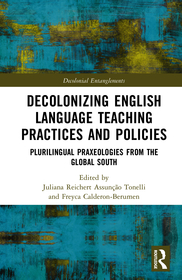
Decolonizing English Language Teaching Practices and Policies
Plurilingual Praxeologies from the Global South
Series: Decolonial Entanglements;
-
GET 10% OFF
- Publisher's listprice GBP 171.99
-
77 653 Ft (73 955 Ft + 5% VAT)
The price is estimated because at the time of ordering we do not know what conversion rates will apply to HUF / product currency when the book arrives. In case HUF is weaker, the price increases slightly, in case HUF is stronger, the price goes lower slightly.
- Discount 10% (cc. 7 766 Ft off)
- Discounted price 69 887 Ft (66 560 Ft + 5% VAT)
69 887 Ft

Availability
Not yet published.
Why don't you give exact delivery time?
Delivery time is estimated on our previous experiences. We give estimations only, because we order from outside Hungary, and the delivery time mainly depends on how quickly the publisher supplies the book. Faster or slower deliveries both happen, but we do our best to supply as quickly as possible.
Product details:
- Edition number 1
- Publisher Routledge
- Date of Publication 26 October 2026
- ISBN 9781041268789
- Binding Hardback
- No. of pages282 pages
- Size 229x152 mm
- Language English
- Illustrations 23 Illustrations, black & white; 18 Halftones, black & white; 5 Line drawings, black & white; 6 Tables, black & white 700
Categories
Short description:
This book brings together teachers and scholars from the Global South to showcase original frameworks and perspectives on decolonizing English language teaching.
MoreLong description:
This book brings together teachers and scholars from the Global South to showcase original frameworks and perspectives on decolonizing English language teaching.
The contributors introduce local praxiologies, understood as the knowledges that emerge through critical reflection from teachers' everyday practices. In this sense, praxiologies can also be taken as informed teaching actions, conceived within decolonial frameworks and embedded in practice. The book addresses issues related to the multiple epistemological stances teachers use to open space within formal educational settings to practice global Englishes, contesting traditional standardized instruction. The first three sections are organized by educational level (primary/basic, secondary, and higher education), with each chapter providing examples of pedagogical practices or methodologies, epistemological frameworks, or diverse approaches to policies regarding English language teaching. The final section interrogates the foundational role of language policy in sustaining or dismantling colonial power structures within education systems. Through these chapters, the authors argue that decolonizing language policies extends beyond a theoretical exercise into a material necessity for transforming educational practice.
Essential reading for scholars and students interested in decolonial teaching practices, Global South epistemologies, English language teaching, critical language pedagogies, and language policy studies.
MoreTable of Contents:
Introduction – Juliana Tonelli and Freyca Calderon Section I: Early Childhood and Primary Education (Early years to approx. 14 years old), Chapter 1: Decolonial Transdisciplinary Movements in Language Education in a Brazilian Public-School Context - Maria José Hoelzle and Rosane Rocha Pessoa Chapter 2: Decolonizing the English Language Curriculum for and with children: a borderless ontological proposal - Juliana Tonelli and Jaqueline Toneli Chapter 3: Translingualand Program: Opportunities of the Implementation of Translanguaging as an Alternative Pedagogy in Two Public Schools from Pereira, Colombia - Angélica Arcila Ramírez, Dany Andrés Hoyos Serna, and Sandro Alfonso Echeverry Palacio Chapter 4. Bridging the Gap: Local Appropriations of CLIL for Transformative Bilingual Education in a Public School in Barranquilla - Yeisy Molina-Siado and Nayibe Rosado-Mendinueta Section II: Secondary Education (approx. 15 to 19 years old) Chapter 5: The process of teaching and learning of English in the presence of the national bilingual plan in Colombia - Elcy Lucia Cañas Areiza and Iris Rubi Monroy-Velasco Chapter 6: Translanguaging and Critical Literacy as Pedagogies for Decolonial Co-Learning in Plurilingual Secondary Schooling Spaces – Kevin Donley Chapter 7: Between Policy and Practice: Challenging Colonial Assessment in High School Mexican and Brazilian Classrooms - Elsa Fernanda González and Gladys Quevedo-Camargo Section III: Higher Education (Post-Secondary) Chapter 8: Critical American Language Praxis in the US higher education – Magdalena Madany-Saa and Jason Litzenberg Chapter 9: Linguistic Policies in Higher Education: Between Global Standardization and Plurilingual Justice – Alina Martinez Hernández, Gabriela Jacqueline Galeas Arboleda and Jardel Coutinho dos Santos Chapter 10: Decolonizing Language Settlement Programs – Wanda Shell Chapter 11: Reflecting on Plurilingualism and Plurilingual Practices: English Language Education in the Interiors of Indonesian Archipelago - Dinny Risri Aletheiani Chapter 12: Teaching in the Tension of Coloniality: Critical reflexivity and Decolonizing Becoming in Teacher Education - Freyca Calderon Section IV: Decolonizing Language Policies Chapter 13: Can Translanguaging Help Decolonize Language Education? Interrogating the Role of Language Policy Reform - Nirda G. Derose, Karina Oliveira de Paula, Michelle Angelo-Rocha, and Robert Gonzaga Mukasa Chapter 14: Challenging Linguistic Racism and Classism: Paving the Way for Decolonial Language Policies in Colombia – Maure Carolina Aguirre Ortega Chapter 15: Social justice and interculturality in language teacher education: The case of a university context in Oaxaca - Jorge Valtierra-Zamudio, Vilma Huerta Cordova, and Mario E. López-Gopar Chapter 16: Policy Barriers and Bridges to Decolonial Praxis in Ecuadorian Intercultural Bilingual Education – Kevin Donley Chapter 17: A Transformative Proposal in Deaf Language Education: Translanguaging, Decoloniality and Social Justice in Dialogue – Cláudia Hilsdorf Rocha and Jéssica Vasconcelos Dorta Afterword - Sangeeta Bagga-Gupta
More
