

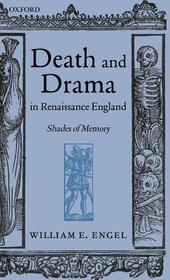
Death and Drama in Renaissance England
Shades of Memory
- Publisher's listprice GBP 177.50
-
80 141 Ft (76 325 Ft + 5% VAT)
The price is estimated because at the time of ordering we do not know what conversion rates will apply to HUF / product currency when the book arrives. In case HUF is weaker, the price increases slightly, in case HUF is stronger, the price goes lower slightly.
- Discount 10% (cc. 8 014 Ft off)
- Discounted price 72 127 Ft (68 693 Ft + 5% VAT)
Subcribe now and take benefit of a favourable price.
Subscribe
80 141 Ft

Availability
printed on demand
Why don't you give exact delivery time?
Delivery time is estimated on our previous experiences. We give estimations only, because we order from outside Hungary, and the delivery time mainly depends on how quickly the publisher supplies the book. Faster or slower deliveries both happen, but we do our best to supply as quickly as possible.
Product details:
- Publisher OUP Oxford
- Date of Publication 7 November 2002
- ISBN 9780199257621
- Binding Hardback
- No. of pages214 pages
- Size 224x144x16 mm
- Weight 333 g
- Language English
- Illustrations numerous halftones 0
Categories
Short description:
Drawing on a range of works from the English Renaissance, Death and Drama in Renaissance England offers a novel way to understand, in their original contexts, key aspects of Renaissance mental life and letters. Focusing on the classical Memory Arts, William Engel explores issues of death and decline in exemplary dramas, dictionaries, and histories of the period, and demonstrates the ways in which emblems and memory images were used to communicate special meanings.
MoreLong description:
Drawing on a range of works from the English Renaissance, Death and Drama in Renaissance England offers a novel way to understand, in their original contexts, key aspects of Renaissance mental life and letters. Focusing on the classical Memory Arts, William Engel explores issues of death and decline in exemplary dramas, dictionaries, and histories of the period, and demonstrates the ways in which emblems and memory images were used to communicate special meanings.
Special attention is given, initially, to select tragedies by Shakespeare and other contemporary playwrights who stages spectacles of silent death. This is followed by a survey of the end to which foreign language phrase-books crafted highly mannered vignettes of daily life, and a discussion of the ways in which metaphors of the stage were translated into a body of work which portrayed the soul of history in terms of an overriding Aesthetic of Decline. The result is a thought-provoking account of the essentially mnemonic principles of design informing and animating a range of works from the English Renaissance.
...will certainly reinvigorate early modern memory studies, and Engel remains the Renaissance memory arts' most eloquent spokesperson.
Table of Contents:
List of illustrations
Note on conventions used in the text
Preface
Introduction: 'Take Away But One Letter': The Spirit of Decline
I. Staging kinetic emblems of fatal destiny
'Commonplaces of memory': visual regimes and charmed spaces
'But yet each circumstance I taste not fully': spectacles of ruin
II. The true work of translation
'Touching my translation': linguistic decorum and memory's domain
III. The marrow and moral of history
'O eloquent, iust, and mighty Death!': ending The History of the World
'More easie to the readers memory': using The History of the World
Conclusion: 'Simulars of the dead': a final declension
Appendix: The end of Ralegh's History of the World
Bibliography
Index

