

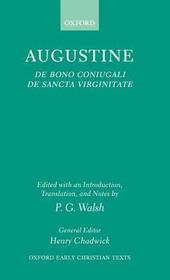
De Bono Coniugali and De Sancta Virginitate
Series: Oxford Early Christian Texts;
- Publisher's listprice GBP 202.50
-
91 428 Ft (87 075 Ft + 5% VAT)
The price is estimated because at the time of ordering we do not know what conversion rates will apply to HUF / product currency when the book arrives. In case HUF is weaker, the price increases slightly, in case HUF is stronger, the price goes lower slightly.
- Discount 10% (cc. 9 142 Ft off)
- Discounted price 82 286 Ft (78 368 Ft + 5% VAT)
Subcribe now and take benefit of a favourable price.
Subscribe
91 428 Ft

Availability
printed on demand
Why don't you give exact delivery time?
Delivery time is estimated on our previous experiences. We give estimations only, because we order from outside Hungary, and the delivery time mainly depends on how quickly the publisher supplies the book. Faster or slower deliveries both happen, but we do our best to supply as quickly as possible.
Product details:
- Publisher OUP Oxford
- Date of Publication 8 March 2001
- ISBN 9780198269953
- Binding Hardback
- No. of pages200 pages
- Size 224x145x15 mm
- Weight 350 g
- Language English 0
Categories
Short description:
De bono coniugali and De sancta virginitate were written in the same year (AD 401). In them Augustine rebuffs the Manichees, who argued that marriage was evil, and the followers of Jovinian, who argued that the married state was as meritorious as that of virginity. The first work analyses why marriage is good, and the second why virginity is a higher good. Both are closely related to present-day controversies amongst theologians and social historians. This edition includes the Latin text, a new translation, an introduction, and explanatory notes.
MoreLong description:
De bono coniugali and De sancta virginitate were written in the same year (AD 401). In them Augustine rebuffs the Manichees, who argued that marriage was evil, and the fellowers of Jovinian, who argued that the married state was as meritorious as that of virginity. The first work analyses why marriage is good, and the second why virginity is a higher good. Both are closely related to present-day controversies amongst theologians and social historians.
These two treatises have been neglected until recently, but lately there has been an outpouring of books and articles on the role of women in the societies of Rome and early Christianity. Moreover, Augustine has received and is continuing to receive enhanced attention in the English-speaking world. No new edition of these works has been published since 1900, and there is no contemporary English translation in print. This new translation and edition of the text will be of value both to readers who wish to consult the original Latin, and to those interested in the social history of early Christianity, and in the intellectual development of Augustine in his early years as bishop of Hippo.
The notes are very useful, providing references to a range of classical and Christian authors, as well as to modern literature.

