

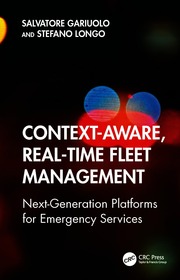
Context-Aware, Real-Time Fleet Management
Next-Generation Platforms for Emergency Services
-
GET 10% OFF
- Publisher's listprice GBP 91.99
-
41 533 Ft (39 555 Ft + 5% VAT)
The price is estimated because at the time of ordering we do not know what conversion rates will apply to HUF / product currency when the book arrives. In case HUF is weaker, the price increases slightly, in case HUF is stronger, the price goes lower slightly.
- Discount 10% (cc. 4 153 Ft off)
- Discounted price 37 379 Ft (35 600 Ft + 5% VAT)
37 379 Ft

Availability
Not yet published.
Why don't you give exact delivery time?
Delivery time is estimated on our previous experiences. We give estimations only, because we order from outside Hungary, and the delivery time mainly depends on how quickly the publisher supplies the book. Faster or slower deliveries both happen, but we do our best to supply as quickly as possible.
Product details:
- Edition number 1
- Publisher CRC Press
- Date of Publication 24 September 2026
- ISBN 9781041172130
- Binding Hardback
- No. of pages264 pages
- Size 234x156 mm
- Language English
- Illustrations 88 Illustrations, black & white; 31 Halftones, black & white; 57 Line drawings, black & white; 10 Tables, black & white 700
Categories
Short description:
This book examines how connected vehicle platforms - the technological backbone of modern fleet management - can be designed to meet the operational requirements of emergency services. By integrating vehicle and context data in real time these platforms enable faster and more consistent decision-making.
MoreLong description:
In an emergency, every second counts, and even a small mistake can cost lives. Yet emergency fleets - ambulances, fire trucks, and police vehicles - still rely on platforms that are unable to integrate the diverse data needed to support accurate, reliable, and timely decisions. Selecting which vehicle to dispatch to an emergency is one such decision - a task that is complex, stressful, and prone to error with conventional dispatch systems.
This book examines how connected vehicle platforms - the technological backbone of modern fleet management - can be designed to meet the operational requirements of emergency services. By integrating vehicle and context data in real time - covering everything from vehicle status to staff availability, crew skills, shift schedules, traffic, and weather - these platforms enable faster and more consistent decision-making. Using the UK National Health Service ambulance fleet as a case study, the book presents a prototype system that automates ambulance dispatch, demonstrating how a thoughtfully designed platform can deliver performance and capabilities far beyond conventional fleet management systems.
Features:
- Presents a comprehensive overview of fleet management with core principles and provides essential knowledge for understanding and improving fleet management.
- Highlights the value of custom-built data platforms, which enable more efficient and effective fleet management than conventional, off-the-shelf systems.
- Explains how to design fleet management systems from system requirements, offering a unique engineering approach not found in other books.
- Includes an end-to-end development process and covers the full process from design through testing, providing a practical, hands-on guide for creating effective fleet management solutions.
- Demonstrates how real-time integration of vehicle data and context data transforms the management of the UK NHS ambulance fleet.
For fleet managers, emergency service professionals, researchers, and policymakers, this book provides a roadmap to improve fleet performance, reduce operational risk, and ultimately save lives - showing why every fleet needs a data platform tailored to its unique requirements.
Table of Contents:
1. Introduction 2. Overview of the State-of-the-Art 3. Case Study: Ambulance Fleet 4. Data Storage Infrastructure 5. Data Communication Infrastructure 6. Vehicle Interface 7. User Interfaces 8. Data Platform Testing 9. Conclusions
More
