

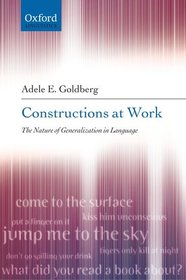
Constructions at Work
The nature of generalization in language
- Publisher's listprice GBP 76.00
-
34 314 Ft (32 680 Ft + 5% VAT)
The price is estimated because at the time of ordering we do not know what conversion rates will apply to HUF / product currency when the book arrives. In case HUF is weaker, the price increases slightly, in case HUF is stronger, the price goes lower slightly.
- Discount 10% (cc. 3 431 Ft off)
- Discounted price 30 883 Ft (29 412 Ft + 5% VAT)
Subcribe now and take benefit of a favourable price.
Subscribe
34 314 Ft

Availability
printed on demand
Why don't you give exact delivery time?
Delivery time is estimated on our previous experiences. We give estimations only, because we order from outside Hungary, and the delivery time mainly depends on how quickly the publisher supplies the book. Faster or slower deliveries both happen, but we do our best to supply as quickly as possible.
Product details:
- Publisher OUP Oxford
- Date of Publication 22 December 2005
- ISBN 9780199268511
- Binding Hardback
- No. of pages292 pages
- Size 242x162x21 mm
- Weight 590 g
- Language English
- Illustrations Tables and line drawings 0
Categories
Short description:
This book investigates the nature of generalization in language and examines how language is known by adults and acquired by children. It looks at how and why constructions are learned, the relation between their forms and functions, and how cross-linguistic and language-internal generalizations about them can be explained.
MoreLong description:
This book investigates the nature of generalization in language and examines how language is known by adults and acquired by children. It looks at how and why constructions are learned, the relation between their forms and functions, and how cross-linguistic and language-internal generalizations about them can be explained.
Constructions at Work is divided into three parts: in the first Professor Goldberg provides an overview of constructionist approaches, including the constructionist approach to argument structure, and argues for a usage-based model of grammar. In Part II she addresses issues concerning how generalizations are constrained and constructional generalizations are learned. In Part III the author shows that a combination of function and processing accounts for a wide range of language-internal and cross-linguistic generalizations. She then considers the degree to which the function of constructions explains their distribution and examines cross-linguistic tendencies in argument realization. She demonstrates that pragmatic and cognitive processes account for the data without appeal to stipulations that are language-specific.
This book is an important contribution to the study of how language operates in the mind and in the world and how these operations relate. It is of central interest for scholars and graduate-level students in all branches of theoretical linguistics and psycholinguistics. It will also appeal to cognitive scientists and philosophers concerned with language and its acquisition.
Its value lies in the engagement with many important theoretical issues in syntactic and acquisition research and in the empirical support marshaled, especially with respect to acquisition.
Table of Contents:
Part One: Constructions
Overview
Surface Generalizations
Item Specific Knowledge and Generalizations
Part Two: Learning Generalizations
How Generalizations are Learned
How Generalizations are Constrained
Why Generalizations are Learned
Part Three: Explaining Generalizations
Island Constraints and Scope
Grammatical Categorization: Subject Auxiliary Inversion
Cross-linguistic Generalizations in Argument Realization
Variations on a Constructionist Theme
Conclusion
References
Index

