

- Publisher's listprice GBP 97.00
-
43 795 Ft (41 710 Ft + 5% VAT)
The price is estimated because at the time of ordering we do not know what conversion rates will apply to HUF / product currency when the book arrives. In case HUF is weaker, the price increases slightly, in case HUF is stronger, the price goes lower slightly.
- Discount 10% (cc. 4 379 Ft off)
- Discounted price 39 416 Ft (37 539 Ft + 5% VAT)
Subcribe now and take benefit of a favourable price.
Subscribe
43 795 Ft

Availability
printed on demand
Why don't you give exact delivery time?
Delivery time is estimated on our previous experiences. We give estimations only, because we order from outside Hungary, and the delivery time mainly depends on how quickly the publisher supplies the book. Faster or slower deliveries both happen, but we do our best to supply as quickly as possible.
Product details:
- Publisher OUP Oxford
- Date of Publication 28 May 1998
- ISBN 9780198523475
- Binding Hardback
- No. of pages192 pages
- Size 242x160x15 mm
- Weight 429 g
- Language English
- Illustrations line figures 0
Categories
Short description:
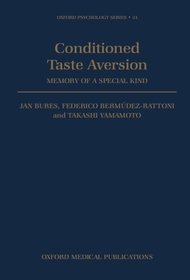
Conditioned taste aversion (CTA) is a robust defence device protecting animals against repeated consumption of toxic food. It has a number of unusual properties contrasting sharply with the basic assumptions of traditional learning theories, which has brought it increasingly to the attention of neurobiologists interested in neural plasticity. This book, written by world experts in the subject, reviews the current state of research into CTA. The first book of its kind to provide an up-to-date summary of research into the neuroanatomy, pharmacology, electrophysiology, and functional morphology of CTA, it will be welcomed by all researchers and graduate students in the field.
MoreLong description:
Conditioned taste aversion (CTA) is a robust defence device protecting animals against repeated consumption of toxic food. It is characterised by the ability of many animals to learn to avoid certain substances by their sight, smell, or taste after experiencing an unpleasant or harmful reaction to them. CTA is encountered at all levels of evolution, with similar forms of food aversion learning found in vertebrate and invertebrate species whose ancestral lines diverged more than 500 million years ago. CTA has a number of unusual properties contrasting sharply with the basic assumptions of traditional learning theories, which has brought it increasingly to the attention of neurobiologists interested in neural plasticity. In CTA, the usual time parameters between stimulus and aversion are relaxed considerably, frequently with delays of hours rather than seconds. Moreover, the critical stage of CTA acquisition may proceed under deep anaesthesia incompatible with other forms of learning. In the past decade several pivotal discoveries have considerably avanced our understanding of the neural processes underlying CTA, and opened new possibilities for their analysis at the molecular and cellular levels. This book, written by three of the world's leading researchers in the subject, comprehensively reviews the current state of research into conditioned taste aversion. The first book of its kind to provide an up-to-date summary of research into the neuroanatomy, pharmacology, electrophysiology, and functional morphology of CTA, it will be welcomed by all researchers and graduate students in the field.
MoreTable of Contents:
Preface
Ethology, physiological psychology, and neurobiology of CTA
The CTA paradigm: Terminology, methods, and conventions
Neuroanatomy of CTA: Lesions studies
Functional ablation studies of CTA
Pharmacology of CTA
Electrophysiology of CTA
Funtional morphology of CTA
Transplantation studies
Paradoxes, projections, and perspectives of CTA research
References
Index

