

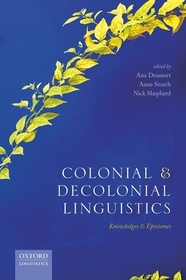
Colonial and Decolonial Linguistics
Knowledges and Epistemes
- Publisher's listprice GBP 110.00
-
49 665 Ft (47 300 Ft + 5% VAT)
The price is estimated because at the time of ordering we do not know what conversion rates will apply to HUF / product currency when the book arrives. In case HUF is weaker, the price increases slightly, in case HUF is stronger, the price goes lower slightly.
- Discount 10% (cc. 4 967 Ft off)
- Discounted price 44 699 Ft (42 570 Ft + 5% VAT)
Subcribe now and take benefit of a favourable price.
Subscribe
49 665 Ft

Availability
printed on demand
Why don't you give exact delivery time?
Delivery time is estimated on our previous experiences. We give estimations only, because we order from outside Hungary, and the delivery time mainly depends on how quickly the publisher supplies the book. Faster or slower deliveries both happen, but we do our best to supply as quickly as possible.
Product details:
- Edition number 1
- Publisher OUP Oxford
- Date of Publication 10 December 2020
- ISBN 9780198793205
- Binding Hardback
- No. of pages400 pages
- Size 240x165x30 mm
- Weight 760 g
- Language English 61
Categories
Short description:
This volume offers a detailed exploration of coloniality in the discipline of linguistics, with case studies drawn from across the world. The chapters provide a nuanced account of the coloniality of linguistics at the level of knowledge and disciplinary practice, and expand their discussion to imagine a decolonial linguistics.
MoreLong description:
This wide-ranging volume offers a detailed exploration of coloniality in the discipline of linguistics, with case studies drawn from Africa, Southeast Asia, Europe, and the Caribbean. Colonial meanings and legacies have returned to the forefront of many academic fields in recent years and linguistics, like several other disciplines, has had an ambivalent relationship with its own histories of practice in colonial and postcolonial worlds. The implications of these histories are still felt today, as colonial paradigms of knowledge production continue to shape both academic linguistic practices and non-specialist discussion of language and culture. The chapters in this volume adopt a range of different conceptual frameworks - including postcolonial theory, southern theory, and decolonial thinking - to provide a nuanced account of the coloniality of linguistics at the level of knowledge and disciplinary practice; crucially, the contributors also expand their investigations beyond this ambivalent inheritance to imagine a decolonial linguistics. The volume will be of interest to all linguists looking to critically assess their own practices and to engage with debates at the cutting-edge of their discipline, particularly in the areas of sociolinguistics, field linguistics, typology, and linguistic anthropology, as well as to those outside the discipline engaging with questions of coloniality.
MoreTable of Contents:
Introduction: Colonial linguistics then and now
Part I: In the Midst
Northern perspectives on language and society in India
Transcending the colonial? Colonial linguistics and George Grierson's Linguistic Survey of India
Using lusitanization and creolization as frameworks to analyze historical and contemporary Cape Verde language policy and planning
On colonization and 'awesome materiality'. A commentary
Part II: Echoes, Traces
Tracing de-/colonial options in German Philology around 1900: The two faces of Hermann Paul (1846-1921)
War and grammar: Acoustic recordings with African prisoners of the First World War (1915-18)
Accomplished works and facts. The family tree project of Africanistics
Linguistics and language in the global economy of knowledge. A commentary
Part III: On the Poetics of Iconoclasm
Researching lesser-used endangered languages: Exploring field and documentary linguistics' perspectives on language research
The missionary in the theatre of linguistics: Or, is a decolonial linguistics possible?
Language ideology and policy in a colonial and postcolonial context: The case of Egypt
The decolonizer iconoclast. A commentary
Part IV: Sounds of Resistance
Jamaican postcolonial writing practices and metalinguistic discourses as a challenge to established norms and standards
Language ideologies and attitudes towards Arabic in contemporary Iran
Decolonizing decolonization? Desiring pure language in Mali
Colonial creep
Decolonial linguistics as paradigm shift. A commentary
Part V: On Decoloniality
A grammar of decoloniality
Walking decolonially with Nick Shepherd

