

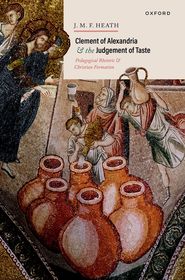
Clement of Alexandria and the Judgement of Taste
Pedagogical Rhetoric and Christian Formation
- Publisher's listprice GBP 80.00
-
36 120 Ft (34 400 Ft + 5% VAT)
The price is estimated because at the time of ordering we do not know what conversion rates will apply to HUF / product currency when the book arrives. In case HUF is weaker, the price increases slightly, in case HUF is stronger, the price goes lower slightly.
- Discount 10% (cc. 3 612 Ft off)
- Discounted price 32 508 Ft (30 960 Ft + 5% VAT)
Subcribe now and take benefit of a favourable price.
Subscribe
36 120 Ft

Availability
Estimated delivery time: In stock at the publisher, but not at Prospero's office. Delivery time approx. 3-5 weeks.
Not in stock at Prospero.
Why don't you give exact delivery time?
Delivery time is estimated on our previous experiences. We give estimations only, because we order from outside Hungary, and the delivery time mainly depends on how quickly the publisher supplies the book. Faster or slower deliveries both happen, but we do our best to supply as quickly as possible.
Product details:
- Publisher OUP Oxford
- Date of Publication 7 May 2024
- ISBN 9780198902010
- Binding Hardback
- No. of pages244 pages
- Size 240x162x20 mm
- Weight 540 g
- Language English 485
Categories
Short description:
J. M. F. Heath reads Clement of Alexandria's Paedagogus alongside modern approaches to the judgement of taste and aesthetics to show how Clement's forming of the tastes and habits of his audience was vital to early Christian beliefs and practices. In turn, the book also develops a theological response to Pierre Bourdieu's theory of taste.
MoreLong description:
Clement of Alexandria and the Judgement of Taste: Pedagogical Rhetoric and Christian Formation provides a new account of Clement of Alexandria's Paedagogus as a programme in the formation of the judgement of taste, situating it in critical dialogue with modern approaches to the judgement of taste and aesthetics. The book's key questions are framed in light of Pierre Bourdieu's Distinction (1979): a landmark in twentieth-century scholarship on the theory of taste. J. M. F. Heath studies Clement's rhetoric and theology in the context of the Christian Second Sophistic, when Christians were experimenting with new ways of inhabiting the rhetorical and philosophical culture of the Greco-Roman world. The Paedagogus shows Clement's pedagogical method and rhetorical strategy at the early stages of Christian formation when his audience are not yet ready for abstract philosophical argument. This was a time for forming people's habits of judgement and preferences of 'taste', so as to ground their daily lives in deeper desires and aversions that are structured through a relationship with God.
This was an immensely important stage of Christian formation: many people never got beyond this to any sort of philosophical curriculum, and yet, through engaging the 'tastes' of a wide audience, Christian leaders sought to spread the gospel--and succeeded in doing so. Even for the intellectual elites, personal formation through preferences of taste was part of how they embodied their desire for God, and the way they inhabited it through the sacramental and ascetic life of the church. Bourdieu's sociological and anthropological approach proves fruitful for understanding aspects of Clement's rhetorical method and purpose, but the study of Clement's theological rhetoric in its cultural context also, in turn, points the way to a theological response to Bourdieu's theory of taste.
Heath's study deserves a wide audience, including readers who might not otherwise consult a work on Clement. Specialists in early Christianity will benefit from Heath's careful treatment of the Paedagogus, a major, understudied text thatallows Heath to display her broad knowledge of Greco-Roman education, philosophy, and diverse second-century Christian movements.
Table of Contents:
Acknowledgements
Introduction: Taste and its Discursive Contexts
Desire: A New Christian Rhetoric of Divine Philanthrōpia
Disgust: Repellent Images (Eikones) in the Pedagogue's Rhetoric
Binaries: Rhetorical Oppositions and the Formation of Aesthetic Judgement
Beauty: Ekphrastic Rhetoric and the Eikōn/Agalma of Human Perfection
Society: Political Rhetoric and the Christian Politeia
Love: Christian Taste and The Ordering of Loves
Bibliography
Index

