

- Publisher's listprice GBP 51.00
-
23 026 Ft (21 930 Ft + 5% VAT)
The price is estimated because at the time of ordering we do not know what conversion rates will apply to HUF / product currency when the book arrives. In case HUF is weaker, the price increases slightly, in case HUF is stronger, the price goes lower slightly.
- Discount 10% (cc. 2 303 Ft off)
- Discounted price 20 724 Ft (19 737 Ft + 5% VAT)
Subcribe now and take benefit of a favourable price.
Subscribe
23 026 Ft

Availability
printed on demand
Why don't you give exact delivery time?
Delivery time is estimated on our previous experiences. We give estimations only, because we order from outside Hungary, and the delivery time mainly depends on how quickly the publisher supplies the book. Faster or slower deliveries both happen, but we do our best to supply as quickly as possible.
Product details:
- Publisher OUP Oxford
- Date of Publication 29 November 2018
- ISBN 9780198794486
- Binding Hardback
- No. of pages268 pages
- Size 240x163x24 mm
- Weight 574 g
- Language English
- Illustrations 12 black and white figures/images 40
Categories
Short description:
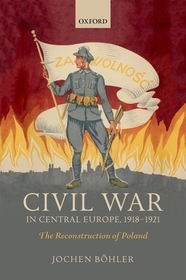
Civil War in Central Europe argues that Polish independence after the First World War was forged in the fires of the post-war conflicts which should be collectively referred to as the Central European Civil War (1918-1921). The ensuing violence forced those living in European border regions to decide on their national identity - German or Polish.
MoreLong description:
The First World War did not end in Central Europe in November 1918. The armistices marked the creation of the Second Polish Republic and the first shot of the Central European Civil War which raged from 1918 to 1921. The fallen German, Russian, and Austrian Empires left in their wake lands with peoples of mixed nationalities and ethnicities. These lands soon became battle grounds and the ethno-political violence that ensued forced those living within them to decide on their national identity.
Civil War in Central Europe seeks to challenge previous notions that such conflicts which occurred between the First and Second World Wars were isolated incidents and argues that they should be considered as part of a European war; a war which transformed Poland into a nation.
...[T]he book is definitely very important and valuable: it shows the formation of the Polish state in a new light that undermines traditional nationalist historiography and popular ideas...The book allows us to go beyond nationalist conventional wisdom.
Table of Contents:
List of Illustrations and Maps
Introduction
Nations, States, and Conflict in Central Europe
How to Mobilize the Polish Nation
The Central European Civil War
Violence and Crimes Beyond the Battlefields
Conclusion
Epilogue

