

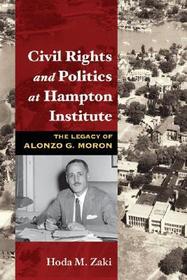
Civil Rights and Politics at Hampton Institute
The Legacy of Alonzo G. Moron
- Publisher's listprice GBP 32.00
-
14 448 Ft (13 760 Ft + 5% VAT)
The price is estimated because at the time of ordering we do not know what conversion rates will apply to HUF / product currency when the book arrives. In case HUF is weaker, the price increases slightly, in case HUF is stronger, the price goes lower slightly.
- Discount 10% (cc. 1 445 Ft off)
- Discounted price 13 003 Ft (12 384 Ft + 5% VAT)
Subcribe now and take benefit of a favourable price.
Subscribe
14 448 Ft

Availability
Temporarily out of stock.
Why don't you give exact delivery time?
Delivery time is estimated on our previous experiences. We give estimations only, because we order from outside Hungary, and the delivery time mainly depends on how quickly the publisher supplies the book. Faster or slower deliveries both happen, but we do our best to supply as quickly as possible.
Product details:
- Publisher University of Illinois Press
- Date of Publication 20 December 2006
- Number of Volumes Hardback
- ISBN 9780252031106
- Binding Hardback
- No. of pages208 pages
- Size 229x152x18 mm
- Weight 481 g
- Language English
- Illustrations 6 photographs 0
Categories
Long description:
Civil Rights and Politics at Hampton Institute presents the story of how one of the preeminent--and historically conservative--private institutions of black higher education came to play an important part in the struggle for full racial equality. Hoda Zaki traces Hampton Institute’s progressive impact to its first black and alumnus president, Alonzo G. Moron, who used his office to launch a powerful and sustained attack against segregation.
A brilliant man, who was uncompromising in his beliefs about creating a more inclusive democracy, Moron struggled against conservative forces both outside of and within his own institution before his ouster by Hampton's predominantly white governing board in 1959--just a year before the Greensboro sit-ins signaled the death knell for the segregationist era in which his institution had prospered. Hoda Zaki details the significance of Moron’s complicated career through discussions of his theories of citizenship education, his work in promoting equal rights as a mission for the college, and the political philosophy (as evidenced in his speeches) that he shared with other civil rights leaders of the era.

