

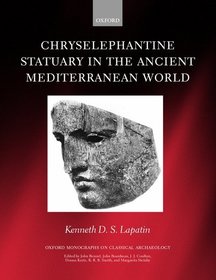
Chryselephantine Statuary in the Ancient Mediterranean World
Series: Oxford Monographs on Classical Archaeology;
- Publisher's listprice GBP 345.00
-
155 767 Ft (148 350 Ft + 5% VAT)
The price is estimated because at the time of ordering we do not know what conversion rates will apply to HUF / product currency when the book arrives. In case HUF is weaker, the price increases slightly, in case HUF is stronger, the price goes lower slightly.
- Discount 10% (cc. 15 577 Ft off)
- Discounted price 140 191 Ft (133 515 Ft + 5% VAT)
Subcribe now and take benefit of a favourable price.
Subscribe
155 767 Ft

Availability
printed on demand
Why don't you give exact delivery time?
Delivery time is estimated on our previous experiences. We give estimations only, because we order from outside Hungary, and the delivery time mainly depends on how quickly the publisher supplies the book. Faster or slower deliveries both happen, but we do our best to supply as quickly as possible.
Product details:
- Publisher OUP Oxford
- Date of Publication 1 November 2001
- ISBN 9780198153115
- Binding Hardback
- No. of pages340 pages
- Size 286x226x27 mm
- Weight 1427 g
- Language English
- Illustrations 14 colour plates, numerous halftone plates and line illustrations 0
Categories
Short description:
Although they do not survive intact, composite statues of gold and ivory were the most acclaimed art form in classical antiquity. Greek and Roman authors make their religious, social, and political importance clear. This study, the first to address the topic as a whole since 1815, presents not only literary references to lost works, but also representations of them in other media, and more importantly, fragmentary survivals that elucidate the techniques employed in their production and the quality achieved by their creators.
MoreLong description:
Composite statues of gold (chrysos), ivory (elephas), and other precious materials were the most celebrated artworks of classical antiquity. Greek and Latin authors leave no doubt that such images provided a centrepiece for religious and civic life and that vast sums were spent to produce them. A number of these statues were the creations of antiquity's most highly acclaimed artists: Polykleitos, Alkamenes, Leochares, and, of course, Pheidias, whose magnificent Zeus Olympios came to be ranked among the Seven Wonders of the World. Although a few individual images such as Pheidias' Athena Parthenos have been the subject of detailed scholarly analysis, chryselephantine statuary as a class, from the exquisite statuettes of Minoan Crete to the majestic temple images constructed by classical Greek city-states and imitated by the Romans, has not received comprehensive study since 1815. This book presents not only the ancient literary and epigraphical evidence for lost statues and examines representations of them in other media, but also assembles and analyses much-neglected physical survivals, elucidating throughout the innovative techniques, such as ivory-bending, employed in their production as well as the variety of social, religious, and political roles they played within the ancient societies that produced them.
A catalogue of fifty-one examples which, while it will not revolutionize the history of ancient art, will put all its historians in his [Lapatin's] debt ... Today's students will rejoice in his forty pages of testimonia in both the original language and translation. But perhaps the most interesting of Lapatin's appendices are his inventories of statues mentioned or described in antiquity and here classified by site, subject and period ... It is not the benefits of autopsy but the virtues of candour and clear-headedness that set this book apart from other works on ivory and colour.

