

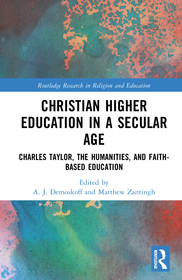
Christian Higher Education in a Secular Age
Charles Taylor, the Humanities, and Faith-Based Education
Series: Routledge Research in Religion and Education;
-
GET 10% OFF
- Publisher's listprice GBP 145.00
-
65 467 Ft (62 350 Ft + 5% VAT)
The price is estimated because at the time of ordering we do not know what conversion rates will apply to HUF / product currency when the book arrives. In case HUF is weaker, the price increases slightly, in case HUF is stronger, the price goes lower slightly.
- Discount 10% (cc. 6 547 Ft off)
- Discounted price 58 921 Ft (56 115 Ft + 5% VAT)
58 921 Ft

Availability
Not yet published.
Why don't you give exact delivery time?
Delivery time is estimated on our previous experiences. We give estimations only, because we order from outside Hungary, and the delivery time mainly depends on how quickly the publisher supplies the book. Faster or slower deliveries both happen, but we do our best to supply as quickly as possible.
Product details:
- Edition number 1
- Publisher Routledge
- Date of Publication 10 June 2026
- ISBN 9781041074335
- Binding Hardback
- No. of pages270 pages
- Size 229x152 mm
- Language English
- Illustrations 1 Illustrations, black & white; 1 Halftones, black & white; 1 Tables, black & white 700
Categories
Short description:
This book explores the implications of Charles Taylor’s analysis of secularity for the work of humanities education in Christian institutions of higher learning.
MoreLong description:
At the heart of this collection of essays is a central question: how can humanistic education in faith-based institutions contribute to human flourishing within secular societies?
This book explores the implications of Charles Taylor’s analysis of secularity for the work of humanities education in Christian institutions of higher learning. It argues that by locating themselves and their scholarship within Taylor’s open frame, scholars can draw on the resources of their disciplinary expertise within the various branches of the humanities to overcome the polarizing tendencies of modern life to the benefit of all. The contributors to the volume challenge and encourage scholars in the humanities to call their students into dialogue with Taylorian themes and concepts as good neighbors working for the flourishing of the academy and the wider world. They draw on Taylor’s discussion of the parable of the Good Samaritan to develop the theme of neighborliness in higher education.
An enlightening study of religion and secularism, the book will be an essential reading for scholars, researchers, and administrators in the fields of religious higher education, religious studies, and the philosophy of education.
Finally, a book that updates the conversation about the role of Christian post-secondary education for our contemporary context without regarding secularism as a dirty word. I welcome this nuanced, critical and serious consideration of the wounds and the gifts of the Christian church to institutions of education.
Beth Green, Provost & Chief Academic Officer, Tyndale University
To say higher ed is in crisis borders now on cliche. But so far much of the answer to this crisis has been faddish and shallow, a redoubling on financial schemes and enrolment gambles. Christian higher ed has the opportunity to lead from ahead, rather than behind, for a return to mission, purpose, and tradition. This Taylor inspired collection shows exactly that potential, from top flight scholars, faculty who increasingly not only can but must lead the charge for the renewal of a sector not just for the good of the church, but of the world.
Robert J. Joustra, Professor of Politics & International Studies, Redeemer University
Some books are better read backwards. Start with Zimmerman’s afterword and let his call for a robustly theological education whose telos is the formation of Christlikeness (for the life of the world) stimulate your interaction with this timely set of essays.
Professor Wesley Olmstead, Briercrest College, Canada
MoreTable of Contents:
Foreword
Introduction
Christian Higher Education: A Neighborly Interpretation
A. J. Demoskoff and Matthew Zantingh
Part I: Spinning the Frame Open
Chapter 1: “Who Is My Neighbor?”: Reading the Good Samaritan Story with Charles Taylor
Susan J. Wendel
Chapter 2: A Spiritual Task for Christian Education in a Secular Age
Neal DeRoo
Chapter 3: “You Will See Heaven Opened”: Reading John’s Gospel in a Secular Age
Joshua J. Coutts
Part II: Interrogating Transcendence and Narratives of Progress in a Secular Age
Chapter 4: Teaching Transcendence: Seeking the Other in a Secular Age
Darren E. Dahl
Chapter 5: The Secularist’s Progress: Interrogating Taylor’s View of Narrative
Robert Piercey
Chapter 6: “A dark and painful chapter in our country’s history”: Higher Time, Memory, and Canadian History
Ken Draper
Part III: Sites of Malaise: The Study of Islam in Christian Higher Education
Chapter 7: Beyond Taylor's 'Other': Reframing Islamic Studies in Catholic Higher Education
Fachrizal Halim
Chapter 8: Teaching Jewish, Christian and Muslim Scripture in a Secular Age
F. Volker Greifenhagen
Chapter 9: The History of Evangelicals Teaching Islam in an Increasingly Secular Age
Alan M. Guenther
Part IV: Reenchanting the Humanities
Chapter 10: Recovering Language in a Secular Age: Charles Taylor and Paul Ricoeur on the Poetics of Religion
Brian Gregor
Chapter 11: Historians and the Apocalypse: Writing and Teaching in an Open Frame
A. J. Demoskoff
Chapter 12: Contemporary Fiction in the Secular Age: Considering Christian “Postsecular” Alternatives
Doug Sikkema
Afterword
Christian Humanism and Education in a Secular Age: The Challenge of Technology
Jens Zimmermann
References
Index

