

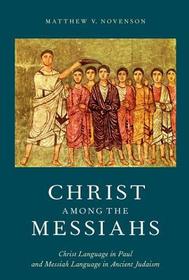
Christ among the Messiahs
Christ Language in Paul and Messiah Language in Ancient Judaism
- Publisher's listprice GBP 53.00
-
23 929 Ft (22 790 Ft + 5% VAT)
The price is estimated because at the time of ordering we do not know what conversion rates will apply to HUF / product currency when the book arrives. In case HUF is weaker, the price increases slightly, in case HUF is stronger, the price goes lower slightly.
- Discount 10% (cc. 2 393 Ft off)
- Discounted price 21 537 Ft (20 511 Ft + 5% VAT)
Subcribe now and take benefit of a favourable price.
Subscribe
23 929 Ft

Availability
printed on demand
Why don't you give exact delivery time?
Delivery time is estimated on our previous experiences. We give estimations only, because we order from outside Hungary, and the delivery time mainly depends on how quickly the publisher supplies the book. Faster or slower deliveries both happen, but we do our best to supply as quickly as possible.
Product details:
- Publisher OUP USA
- Date of Publication 29 October 2015
- ISBN 9780190274092
- Binding Paperback
- No. of pages256 pages
- Size 231x155x20 mm
- Weight 454 g
- Language English 0
Categories
Short description:
Recent scholarship on ancient Judaism, finding only scattered references to messiahs in Hellenistic- and Roman-period texts, has generally concluded that the word ''messiah'' did not mean anything determinate in antiquity.
MoreLong description:
Recent scholarship on ancient Judaism, finding only scattered references to messiahs in Hellenistic- and Roman-period texts, has generally concluded that the word ''messiah'' did not mean anything determinate in antiquity. Meanwhile, interpreters of Paul, faced with his several hundred uses of the Greek word for ''messiah,'' have concluded that christos in Paul does not bear its conventional sense. Against this curious consensus, Matthew V. Novenson argues in Christ among the Messiahs that all contemporary uses of such language, Paul's included, must be taken as evidence for its range of meaning. In other words, early Jewish messiah language is the kind of thing of which Paul's Christ language is an example.
Looking at the modern problem of Christ and Paul, Novenson shows how the scholarly discussion of christos in Paul has often been a cipher for other, more urgent interpretive disputes. He then traces the rise and fall of ''the messianic idea'' in Jewish studies and gives an alternative account of early Jewish messiah language: the convention worked because there existed both an accessible pool of linguistic resources and a community of competent language users. Whereas it is commonly objected that the normal rules for understanding christos do not apply in the case of Paul since he uses the word as a name rather than a title, Novenson shows that christos in Paul is neither a name nor a title but rather a Greek honorific, like Epiphanes or Augustus.
Focusing on several set phrases that have been taken as evidence that Paul either did or did not use christos in its conventional sense, Novenson concludes that the question cannot be settled at the level of formal grammar. Examining nine passages in which Paul comments on how he means the word christos, Novenson shows that they do all that we normally expect any text to do to count as a messiah text. Contrary to much recent research, he argues that Christ language in Paul is itself primary evidence for messiah language in ancient Judaism.
Novenson's argument in this volume appears to be focused, consistent, and overall convincing. His nuanced presentation on the messianic meaning of Paul's Christ language is commendable... I value Novenson's genuine contribution to our understanding of Paul's language.
Table of Contents:
Abbreviations
Introduction
Chapter One: The Modern Problem of Christ and the Messiahs
Chapter Two: Messiah Language in Ancient Judaism
Chapter Three: Names, Titles, and Other Possibilities
Chapter Four: Christ Phrases in Paul
Chapter Five: Christ Passages in Paul
Conclusion
Bibliography
Index of Subjects
Index of Ancient Sources
Index of Modern Authors

