

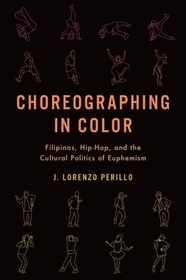
Choreographing in Color
Filipinos, Hip-Hop, and the Cultural Politics of Euphemism
- Publisher's listprice GBP 33.99
-
15 346 Ft (14 615 Ft + 5% VAT)
The price is estimated because at the time of ordering we do not know what conversion rates will apply to HUF / product currency when the book arrives. In case HUF is weaker, the price increases slightly, in case HUF is stronger, the price goes lower slightly.
- Discount 20% (cc. 3 069 Ft off)
- Discounted price 12 277 Ft (11 692 Ft + 5% VAT)
- Discount is valid until: 30 June 2026
Subcribe now and take benefit of a favourable price.
Subscribe
15 346 Ft

Availability
Estimated delivery time: In stock at the publisher, but not at Prospero's office. Delivery time approx. 3-5 weeks.
Not in stock at Prospero.
Why don't you give exact delivery time?
Delivery time is estimated on our previous experiences. We give estimations only, because we order from outside Hungary, and the delivery time mainly depends on how quickly the publisher supplies the book. Faster or slower deliveries both happen, but we do our best to supply as quickly as possible.
Product details:
- Publisher OUP USA
- Date of Publication 30 September 2020
- ISBN 9780190054281
- Binding Paperback
- No. of pages272 pages
- Size 231x155x17 mm
- Weight 408 g
- Language English
- Illustrations 25 figures, 2 tables 42
Categories
Short description:
In Choreographing in Color, J. Lorenzo Perillo draws on nearly two decades of ethnography, choreographic analysis, and community engagement to ask: what does it mean for Filipinos to navigate violent forces of empire and neoliberalism with street dance and Hip-Hop?
MoreLong description:
In Choreographing in Color, J. Lorenzo Perillo investigates the development of Filipino popular dance and performance since the late 20th century. Drawing from nearly two decades of ethnography, choreographic analysis, and community engagement with artists, choreographers, and organizers, Perillo shifts attention away from the predominant Philippine neoliberal and U.S. imperialist emphasis on Filipinos as superb mimics, heroic migrants, model minorities, subservient wives, and natural dancers and instead asks: what does it mean for Filipinos to navigate the violent forces of empire and neoliberalism with street dance and Hip-Hop?
Employing critical race, feminist, and performance studies, Perillo analyzes the conditions of possibility that gave rise to Filipino dance phenomena across viral, migrant, theatrical, competitive, and diplomatic performance in the Philippines and diaspora. Advocating for serious engagements with the dancing body, Perillo rethinks a staple of Hip-Hop's regulation, the "euphemism," as a mode of social critique for understanding how folks have engaged with both racial histories of colonialism and gendered labor migration. Figures of euphemism - the zombie, hero, robot, and judge - constitute a way of seeing Filipino Hip-Hop as contiguous with a multi-racial repertoire of imperial crossing, thus uncovering the ways Black dance intersects Filipino racialization and reframing the ongoing, contested underdog relationship between Filipinos and U.S. global power. Choreographing in Color therefore reveals how the Filipino dancing body has come to be, paradoxically, both globally recognized and indiscernible.
... [B]y also focusing on the historical and embodied relations between Filipinoness and Blackness, Perillo's work follows in the footsteps of hip-hop scholars such as Halifu Osumare and H. Samy Alim. Perillo shares with Osumare and Alim the critical analysis of hip-hop artists that transcend borders and cultures and the complex affinities created by global hip-hop practices.
Table of Contents:
Introduction: Choreographing in Color
Chapter 1: Zombies and Prisoner Rehabilitation
Chapter 2: Heroes and Filipino Migrations
Chapter 3: Robots and Affirmative Choreographies
Chapter 4: Judges and International Competitions
Conclusion: Hip-Hop Ambassadors and Conventions
Notes
Bibliography
Index

