

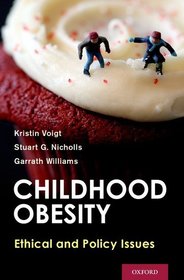
Childhood Obesity
Ethical and Policy Issues
- Publisher's listprice GBP 74.00
-
33 411 Ft (31 820 Ft + 5% VAT)
The price is estimated because at the time of ordering we do not know what conversion rates will apply to HUF / product currency when the book arrives. In case HUF is weaker, the price increases slightly, in case HUF is stronger, the price goes lower slightly.
- Discount % (cc. 0 Ft off)
- Discounted price 0 Ft (0 Ft + 5% VAT)
- Discount is valid until: 5 August 2026
Subcribe now and take benefit of a favourable price.
Subscribe
33 411 Ft

Availability
printed on demand
Why don't you give exact delivery time?
Delivery time is estimated on our previous experiences. We give estimations only, because we order from outside Hungary, and the delivery time mainly depends on how quickly the publisher supplies the book. Faster or slower deliveries both happen, but we do our best to supply as quickly as possible.
Product details:
- Publisher OUP USA
- Date of Publication 15 May 2014
- ISBN 9780199964482
- Binding Hardback
- No. of pages260 pages
- Size 236x157x27 mm
- Weight 476 g
- Language English 0
Categories
Short description:
This book is the first to focus on the ethical and policy issues raised by childhood obesity. The authors, whose backgrounds are in philosophy, epidemiology, and community medicine, address topics including: parental responsibility; equity, stigma and discrimination; proposals to tax foods and drinks; and marketing to children.
MoreLong description:
Childhood obesity has become a central concern in many countries and a range of policies have been proposed or implemented to address it. This co-authored book is the first to focus on the complex set of ethical and policy issues that childhood obesity raises.
Throughout the book, authors Kristin Voigt, Stuart G. Nicholls, and Garrath Williams emphasize that childhood obesity is a multi-faceted phenomenon, and just one of many issues that parents, schools and societies face. They argue that it is important to acknowledge the resulting complexities and not to think in terms "single-issue" policies.
After first reviewing some of the factual uncertainties about childhood obesity, the authors explore central ethical questions. What priority should be given to preventing obesity? To what extent are parents responsible? How should we think about questions of stigma and inequality? In the second part of the book, the authors consider key policy issues, including the concept of the âobesogenic environment,â debates about taxation and marketing, and the role that schools can play in obesity prevention.
The authors argue that political debate is needed to decide the importance given to childhood obesity and how to divide responsibilities for action. These debates have no simple answers. Nonetheless, the authors argue that there are reasons for hope. There are a wide range of opportunities for action. Many of these options also promise wider social benefits.
"This book provides a welcome re-appraisal of commonly-held beliefs about child obesity and misconceptions about what needs to be done. The authors expose the futility of holding parents responsible for children's unhealthy behaviour, they challenge the assumption that education and family support will solve the problem, and they condemn the prejudice and stigma which surround the narrative of blame. The book shows convincingly how the causes of obesity - and the range of associated diseases - lie in the fabric of the modern market economy: in the food supply which shapes our diets, the social and physical environment which encourages sedentary behaviour, and in the media which promote ever greater consumption. Obesity is not the problem: it is the symptom of a more complex social and economic malaise encouraging poor health. The case for interventions by governments to promote health and wellbeing above crude economic growth is comprehensively proven." - Dr. Tim Lobstein, Director of Policy and Programmes, The International Association for the Study of Obesity and The International Obesity Task Force
A well-researched, highly critical, but carefully balanced examination of everyday assumptions about childhood obesity and its prevention from an intensely moral perspective. Although the authors demonstrate that no intervention is without ethical complications or effective entirely on its own, they call for immediate actions to reduce the stigma of childhood obesity, support parents, and create food environments healthier for children, adults, and the environment.- Marion Nestle, Paulette Goddard Professor of Nutrition, Food Studies, and Public Health, NYU Steinhardt School of Culture, Education, and Human Development
A welcome and much needed work which promises to significantly shape future research in the area. The authors draw on an impressive range of sources and support normative claims with solid empirical evidence throughout. The book is clearly written and well-argued and is going to be a landmark in the emerging normative literature on obesity and on public health ethics in general.
Table of Contents:
Introduction
Part I
Chapter 1: Empirical Uncertainty: Some Difficulties in Placing Obesity Centerstage
Chapter 2: Normative Uncertainty: What Do We Want From Policies to Address Childhood Obesity
Chapter 3: Childhood Obesity and Parental Responsibility
Chapter 4: Childhood Obesity Interventions, Equity and Social Justice
Chapter 5: Stigma and Weight Bias: Implications for Childhood Obesity Interventions
Part II
Chapter 6: Childhood Obesity and the 'Obesogenic Environment'
Chapter 7: Price Policies as Strategies for Obesity Prevention
Chapter 8: Responding to Food Marketing Targeted at Children: Regulation, Social Marketing and Media Literacy
Chapter 9: Schools and Childhood Obesity
Conclusion: Childhood Obesity: Some Practical Implications
References

