

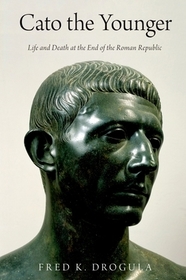
Cato the Younger
Life and Death at the End of the Roman Republic
- Publisher's listprice GBP 24.99
-
11 282 Ft (10 745 Ft + 5% VAT)
The price is estimated because at the time of ordering we do not know what conversion rates will apply to HUF / product currency when the book arrives. In case HUF is weaker, the price increases slightly, in case HUF is stronger, the price goes lower slightly.
- Discount 20% (cc. 2 256 Ft off)
- Discounted price 9 026 Ft (8 596 Ft + 5% VAT)
- Discount is valid until: 30 June 2026
Subcribe now and take benefit of a favourable price.
Subscribe
11 282 Ft

Availability
Estimated delivery time: In stock at the publisher, but not at Prospero's office. Delivery time approx. 3-5 weeks.
Not in stock at Prospero.
Why don't you give exact delivery time?
Delivery time is estimated on our previous experiences. We give estimations only, because we order from outside Hungary, and the delivery time mainly depends on how quickly the publisher supplies the book. Faster or slower deliveries both happen, but we do our best to supply as quickly as possible.
Product details:
- Publisher OUP USA
- Date of Publication 12 October 2021
- ISBN 9780197604373
- Binding Paperback
- No. of pages376 pages
- Size 234x160x23 mm
- Weight 549 g
- Language English
- Illustrations 9 145
Categories
Short description:
Cato the Younger was a nemesis of Julius Caesar, and his sustained antagonism helped to push the Romans towards civil war. He threatened Caesar with violence, resulting in Caesar marching on Rome and hurling the Republic into a bloody civil war. However, Cato never wanted war and took his own life. By providing a new, detailed portrait of Cato, this book presents a unique narrative of the age he helped shape and inadvertently destroy.
MoreLong description:
Marcus Porcius Cato ("the Younger") is most famous for being Julius Caesar's nemesis. His sustained antagonism was in large part responsible for pushing the Romans towards civil war. Yet Cato never wanted war even though he used the threat of violence against Caesar. This strategic gamble misfired as Caesar, instead of yielding, marched on Rome, hurling the Republic into a bloody civil war. Refusing to inhabit a world ruled by Caesar, Cato took his own life. Although the Roman historian Sallust identified Cato and Caesar as the two most outstanding men of their age, modern scholars have tended to dismiss Cato as a cantankerous conservative who, while colorful, was not a critical player in the events that overtook the Republic.
This book, in providing a much-needed reliable biography of Cato, contradicts that assessment. In addition to being Caesar's adversary, Cato is an important and fascinating historical figure in his own right, and his career-in particular, his idiosyncrasies-shed light on the changing political culture of the late Republic. Cato famously reached into Rome's hallowed past and found mannerisms and habits to adopt that transformed him into the foremost champion of ancestral custom. Thus Cato did things that seemed strange and even bizarre such as wearing an old-fashioned tint of purple on his senatorial toga, refusing to ride a horse when on public business, and going about barefoot and without the usual tunic as an undergarment. His extreme conservatism-which became celebrated in later ages, especially in Enlightenment Europe and revolutionary America--was actually designed to give him a unique advantage in Roman politics. This is not to claim that he was insincere in his combative promotion of the mos maiorum (the way of the ancestors), but his political manipulation of the Romans' reverence for their traditions was masterful. By providing a new, detailed portrait of Cato, the book also presents a unique narrative of the age he helped shape and inadvertently destroy.
This is a highly readable book based on immense scholarship, which will appeal to scholars and also to general readers. It not only illuminates Cato's personality and career, but sheds light on the complexity of the late Republic's institutions and why they were unable to endure the onslaught of ambitious politicians and generals.
Table of Contents:
List of Maps, Stemmata, and Figures
Introduction
Chapter One: Family
Chapter Two: Early Years
Chapter Three: Cato the Tribune
Chapter Four: Cato and the Formation of the Triumvirate
Chapter Five: Cato's Cyprian Mission and its Aftermath
Chapter Six: Shifting Alliances
Chapter Seven: Collapse
Chapter Eight: Civil War
Epilogue: Cato the Stoic
Glossary of Terms
Index

