

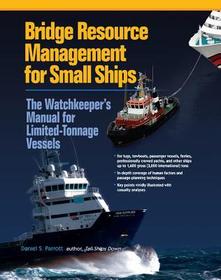
Bridge Resource Management for Small Ships: The Watchkeeper's Manual for Limited-Tonnage Vessels
The Watchkeeper's Manual for Limited-Tonnage Vessels
- Publisher's listprice GBP 53.99
-
24 376 Ft (23 215 Ft + 5% VAT)
The price is estimated because at the time of ordering we do not know what conversion rates will apply to HUF / product currency when the book arrives. In case HUF is weaker, the price increases slightly, in case HUF is stronger, the price goes lower slightly.
- Discount 10% (cc. 2 438 Ft off)
- Discounted price 21 938 Ft (20 894 Ft + 5% VAT)
Subcribe now and take benefit of a favourable price.
Subscribe
24 376 Ft

Availability
Out of print
Why don't you give exact delivery time?
Delivery time is estimated on our previous experiences. We give estimations only, because we order from outside Hungary, and the delivery time mainly depends on how quickly the publisher supplies the book. Faster or slower deliveries both happen, but we do our best to supply as quickly as possible.
Product details:
- Publisher International Marine
- Date of Publication 16 April 2011
- ISBN 9780071550079
- Binding Hardback
- No. of pages192 pages
- Size 287x223x15 mm
- Weight 735 g
- Language English 0
Categories
Short description:
The first book on this required course of training written especially for officers aboard small ships.
MoreLong description:
Your vessel may be equipped with the most advanced technology and the most powerful engines, but the failure to apply the basic principles of bridge resource management can still prevent you from getting where you are going.
Satellite systems, ARPA, electronic charts, AIS, sophisticated communication equipment and integrated navigational systems?all these advanced technologies provide valuable capabilities. But accidents still happen, and they usually involve human error. This simple fact has made Bridge Resource Management (BRM) training a requirement for watchkeepers worldwide. Bridge Resource Management for Small Ships: The Watchkeeper?s Manual for Limited-Tonnage Vessels is the first book to address the unique needs of operators of small ships (limited-tonnage vessels) including tugs, ferries, yachts, and other passenger-carrying vessels.
Features:
- Case histories to illustrate important points
- A complete course in BRM, suited for studying on your own as well as a complement to your classwork
Topics include: Introduction to BRM, Standard Operating Procedures, Passage Planning, Implementing the Passage Plan, Building a Passage Plan, Situational Awareness and Human Factors, including: Overreliance, Distraction, Stress, Fatigue, Complacency, and Transition; and Human Interactions, including Communications, Teams and Teamwork, Decision Making and Leadership, and Human Error
Your vessel may be equipped with the most advanced technology and the most powerful engines, but the failure to apply the basic principles of bridge resource management can still prevent you from getting where you are going.
Satellite systems, ARPA, electronic charts, AIS, sophisticated communication equipment and integrated navigational systems?all these advanced technologies provide valuable capabilities. But accidents still happen, and they usually involve human error. This simple fact has made Bridge Resource Management (BRM) training a requirement for watchkeepers worldwide. Bridge Resource Management for Small Ships: The Watchkeeper?s Manual for Limited-Tonnage Vessels is the first book to address the unique needs of operators of small ships (limited-tonnage vessels) including tugs, ferries, yachts, and other passenger-carrying vessels.
Features:
- Case histories to illustrate important points
- A complete course in BRM, suited for studying on your own as well as a complement to your classwork
Topics include: Introduction to BRM, Standard Operating Procedures, Passage Planning, Implementing the Passage Plan, Building a Passage Plan, Situational Awareness and Human Factors, including: Overreliance, Distraction, Stress, Fatigue, Complacency, and Transition; and Human Interactions, including Communications, Teams and Teamwork, Decision Making and Leadership, and Human Error
More
