

- Publisher's listprice GBP 22.49
-
10 154 Ft (9 670 Ft + 5% VAT)
The price is estimated because at the time of ordering we do not know what conversion rates will apply to HUF / product currency when the book arrives. In case HUF is weaker, the price increases slightly, in case HUF is stronger, the price goes lower slightly.
- Discount 10% (cc. 1 015 Ft off)
- Discounted price 9 138 Ft (8 703 Ft + 5% VAT)
Subcribe now and take benefit of a favourable price.
Subscribe
10 154 Ft

Availability
printed on demand
Why don't you give exact delivery time?
Delivery time is estimated on our previous experiences. We give estimations only, because we order from outside Hungary, and the delivery time mainly depends on how quickly the publisher supplies the book. Faster or slower deliveries both happen, but we do our best to supply as quickly as possible.
Product details:
- Edition number New ed
- Publisher OUP USA
- Date of Publication 29 July 1999
- ISBN 9780195129113
- Binding Paperback
- No. of pages368 pages
- Size 234x156x25 mm
- Weight 522 g
- Language English 0
Categories
Short description:
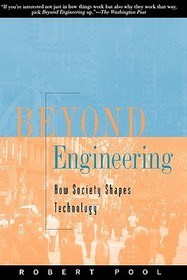
In Beyond Engineering, Robert Pool provides an engaging look at modern technology and an illuminating account of how technology and the modern world shape each other.
MoreLong description:
We have long recognized technology as a driving force behind much historical and cultural change. The invention of the printing press initiated the Reformation. The development of the compass ushered in the Age of Exploration and the discovery of the New World. The cotton gin created the conditions that led to the Civil War. Now, in Beyond Engineering, science writer Robert Pool turns the question around to examine how society shapes technology. Drawing on such disparate fields as history, economics, risk analysis, management science, sociology, and psychology, Pool illuminates the complex, often fascinating interplay between machines and society, in a book that will revolutionize how we think about technology.
We tend to think that reason guides technological development, that engineering expertise alone determines the final form an invention takes. But if you look closely enough at the history of any invention, says Pool, you will find that factors unrelated to engineering seem to have an almost equal impact. In his wide-ranging volume, he traces developments in nuclear energy, automobiles, light bulbs, commercial electricity, and personal computers, to reveal that the ultimate shape of a technology often has as much to do with outside and unforeseen forces. For instance, Pool explores the reasons why steam-powered cars lost out to internal combustion engines. He shows that the Stanley Steamer was in many ways superior to the Model T--it set a land speed record in 1906 of more than 127 miles per hour, it had no transmission (and no transmission headaches), and it was simpler (one Stanley engine had only twenty-two moving parts) and quieter than a petrol engine--but the steamers were killed off by factors that had little or nothing to do with their engineering merits, including the Stanley twins' lack of business acumen and an outbreak of hoof-and-mouth disease. Pool illuminates other aspects of technology as well. He traces how seemingly minor decisions made early along the path of development can have profound consequences further down the road, and perhaps most important, he argues that with the increasing complexity of our technological advances--from nuclear reactors to genetic engineering--the number of things that can go wrong multiplies, making it increasingly difficult to engineer risk out of the equation. Citing such catastrophes as Bhopal, Three Mile Island, the Exxon Valdez, the Challenger, and Chernobyl, he argues that is it time to rethink our approach to technology. The days are gone when machines were solely a product of larger-than-life inventors and hard-working engineers. Increasingly, technology will be a joint effort, with its design shaped not only by engineers and executives but also psychologists, political scientists, management theorists, risk specialists, regulators and courts, and the general public.
Whether discussing bovine growth hormone, molten-salt reactors, or baboon-to-human transplants, Beyond Engineering is an engaging look at modern technology and an illuminating account of how technology and the modern world shape each other.
"It's a truism that technology has driven modern history. In this wise, insightful book, Robert Pool explores the deeper truth that history shapes technology."--Richard Rhodes, author The Making of the Atomic Bomb.

