

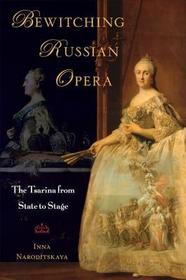
Bewitching Russian Opera
The Tsarina from State to Stage
- Publisher's listprice GBP 115.00
-
51 922 Ft (49 450 Ft + 5% VAT)
The price is estimated because at the time of ordering we do not know what conversion rates will apply to HUF / product currency when the book arrives. In case HUF is weaker, the price increases slightly, in case HUF is stronger, the price goes lower slightly.
- Discount 10% (cc. 5 192 Ft off)
- Discounted price 46 730 Ft (44 505 Ft + 5% VAT)
Subcribe now and take benefit of a favourable price.
Subscribe
51 922 Ft

Availability
printed on demand
Why don't you give exact delivery time?
Delivery time is estimated on our previous experiences. We give estimations only, because we order from outside Hungary, and the delivery time mainly depends on how quickly the publisher supplies the book. Faster or slower deliveries both happen, but we do our best to supply as quickly as possible.
Product details:
- Publisher OUP USA
- Date of Publication 16 February 2012
- ISBN 9780195340587
- Binding Hardback
- No. of pages416 pages
- Size 165x239x38 mm
- Weight 743 g
- Language English
- Illustrations 72 music examples and 9 halftone illustrations 0
Categories
Short description:
In Bewitching Russian Opera , Inna Naroditskaya investigates the musical lives of four female monarchs who ruled Russia for most of the eighteenth century - Catherine I, Anna, Elizabeth, and Catherine the Great. Engaging with ethnomusicological, historical, and philological approaches, her study traces the tsarinas' deeply invested interest in musical drama, as each built theaters, established drama schools, commissioned operas and ballets, and themselves wrote and produced musical plays. Naroditskaya examines the creative output of the tsarinas across the contexts in which they worked and lived, revealing significant connections between their personal creative aspirations and contemporary musical-theatrical practices, and the political and state affairs conducted during their reigns. Bewitching Russian Opera ultimately demonstrates that the theater served as an experimental space for these imperial women, in which they rehearsed, probed, and formulated gender and class roles, and enacted on the musical stage political ambitions and international conquests which they would later carry out on the world stage itself.
MoreLong description:
In Bewitching Russian Opera: The Tsarina from State to Stage, Inna Naroditskaya investigates the musical lives of four female monarchs who ruled Russia for most of the eighteenth century - Catherine I, Anna, Elizabeth, and Catherine the Great. Engaging with ethnomusicological, historical, and philological approaches, her study traces the tsarinas' deeply invested interest in musical drama, as each built theaters, established drama schools, commissioned operas and ballets, and themselves wrote and produced musical plays. Naroditskaya examines the creative output of the tsarinas across the contexts in which they worked and lived, revealing significant connections between their personal creative aspirations and contemporary musical-theatrical practices, and the political and state affairs conducted during their reigns. Bewitching Russian Opera ultimately demonstrates that the theater served as an experimental space for these imperial women, in which they rehearsed, probed, and formulated gender and class roles, and enacted on the musical stage political ambitions and international conquests which they would later carry out on the world stage itself.
Beginning with the eighteenth-century imperial court, Naroditskaya illustrates the increased theatricality of the court and the popularity of musical theater among nobles, which occurred alongside an appropriation of folk and court ceremonies into the theater. Through contemporary performance theory, she demonstrates how the opportunity for role-playing and costume-changing in performative spaces allowed individuals to cross otherwise rigid boundaries of class and gender. A close look at a series of operas and musical theater productions - from Catherine the Great's fairy tale operas to Tchaikovsky's Pique Dame - illuminates the transition of these royal women from powerful political and cultural figures during their own reigns, to a marginalized and unreal Other under the patriarchal dominance of the subsequent period. These tsarinas successfully fostered the concept of a modern nation and collective national identity, only to then have their power and influence undone in Russian cultural consciousness through the fairy-tales operas of the 19th century that positioned tsarinas as "magical" and dangerous figures rightfully displaced and conquered--by triumphant heroes on the stage, and by the new patriarchal rulers in the state.
The author makes her arguments in a refreshingly conversational style that avoids jargon, and her writing about music dazzles. Reading this important book is like enjoying an evening of opera with an in-the-know friend who keeps whispering gem-like observations. Russian opera deserves this fresh perspective.
Table of Contents:
Introduction
Overture: Russia's Imperial Prima Donnas
1. Russian Minervas Staging Empire
2. The Play of Possibilities: Serfs Enacting Aristocrats and Countesses Playing Peasants
3. Catherine the Empress(ario): Making Tales into Princely Operas
4. Oleg at the Roots of Russian Historical Opera
Interlude: to Patria and Nation
5. Ruslan and Liudmila
6. Rusalka: Water, Power, and Women
7. Mlada and Inescapable Female Circle
8. Sadko: He is the Hero!
9. Queen of Spades
Bibliography

