

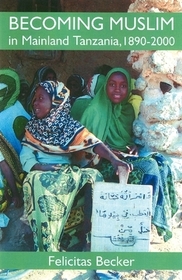
Becoming Muslim in Mainland Tanzania, 1890-2000
The Spread of Islam Beyond the Indian Ocean Coast
Series: British Academy Monographs;
- Publisher's listprice GBP 75.00
-
33 862 Ft (32 250 Ft + 5% VAT)
The price is estimated because at the time of ordering we do not know what conversion rates will apply to HUF / product currency when the book arrives. In case HUF is weaker, the price increases slightly, in case HUF is stronger, the price goes lower slightly.
- Discount 10% (cc. 3 386 Ft off)
- Discounted price 30 476 Ft (29 025 Ft + 5% VAT)
Subcribe now and take benefit of a favourable price.
Subscribe
33 862 Ft

Availability
Estimated delivery time: In stock at the publisher, but not at Prospero's office. Delivery time approx. 3-5 weeks.
Not in stock at Prospero.
Why don't you give exact delivery time?
Delivery time is estimated on our previous experiences. We give estimations only, because we order from outside Hungary, and the delivery time mainly depends on how quickly the publisher supplies the book. Faster or slower deliveries both happen, but we do our best to supply as quickly as possible.
Product details:
- Publisher OUP Oxford
- Date of Publication 11 September 2008
- ISBN 9780197264270
- Binding Hardback
- No. of pages390 pages
- Size 241x161x26 mm
- Weight 756 g
- Language English
- Illustrations 12 plates, 2 maps 0
Categories
Short description:
Tanzania has moved from widespread conversion to Islam in the early twentieth century to recent bitter disputes over Islamic radicalism. Using a combination of government, mission and oral records, this volume examines the intellectual and social forces behind these transitions.
MoreLong description:
We know that many people converted to Islam in colonial East Africa, but the why and how remain obscure. Recently, these Muslim congregations have come under scrutiny for producing Islamic radicals, but again the causes are poorly understood.
This book traces the history of Muslim congregations in a mainland Tanzanian region from their inception in the early twentieth century to the early 2000s, using the records of governments and missions as well as hundreds of interviews. It argues that rural villagers became Muslim of their own initiative, in the pursuit of more equitable relations with Muslim townspeople and among themselves. The egalitarian ethos of these rural Muslims resonated with that of Tanzania's movement for independence, in which they strongly participated. The current conflicts among Muslims are rooted partly in their shifting and problematic relationship with successive post-independence governments, but also in the transitions in gender relations, education and ritual observance to which Islamization has contributed.
This is a highly valuable book, which covers a lot of ground and is based on extensive archival research, including German colonial and missionary records. It also draws extensively on oral history - including about 300 interviews with local informants.
Table of Contents:
Introduction
Migration, trade, and religious change at the onset of colonialism, 1890-1905
From Muslim big men to rural waalimu, 1905-27
Teachers, elders and shehe: how Islam came to the villages
The growth of rural madrasa
The book, the wilderness, and the family: Islamic doctrine and African practice
The heritage of slavery and the educationalist shehe of the Sufi brotherhoods
New horizons: the era of independence, 1954-67
Internal debates and international influences: the rise of Islamic radicalism in the 1990s
Conclusion

