

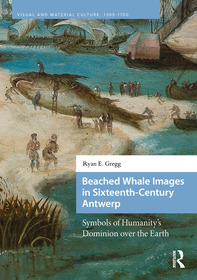
Beached Whale Images in Sixteenth-Century Antwerp
Symbols of Humanity’s Dominion over the Earth
Series: Visual and Material Culture, 1300-1700;
- Publisher's listprice GBP 155.00
-
69 982 Ft (66 650 Ft + 5% VAT)
The price is estimated because at the time of ordering we do not know what conversion rates will apply to HUF / product currency when the book arrives. In case HUF is weaker, the price increases slightly, in case HUF is stronger, the price goes lower slightly.
- Discount 20% (cc. 13 996 Ft off)
- Discounted price 55 986 Ft (53 320 Ft + 5% VAT)
- Discount is valid until: 30 June 2026
Subcribe now and take benefit of a favourable price.
Subscribe
62 984 Ft

Availability
Estimated delivery time: In stock at the publisher, but not at Prospero's office. Delivery time approx. 3-5 weeks.
Not in stock at Prospero.
Why don't you give exact delivery time?
Delivery time is estimated on our previous experiences. We give estimations only, because we order from outside Hungary, and the delivery time mainly depends on how quickly the publisher supplies the book. Faster or slower deliveries both happen, but we do our best to supply as quickly as possible.
Product details:
- Edition number 1
- Publisher Routledge
- Date of Publication 16 April 2026
- ISBN 9789048566242
- Binding Hardback
- No. of pages198 pages
- Size 246x174 mm
- Weight 530 g
- Language English
- Illustrations 54 Illustrations, black & white; 9 Illustrations, color; 54 Halftones, black & white; 9 Halftones, color 687
Categories
Short description:
This book examines a small group of sixteenth-century Antwerp artworks depicting the butchering of beached whales, revealing how these images represent a pivotal moment in European attitudes toward nature.
More
Long description:
This book examines a small group of sixteenth-century Antwerp artworks depicting the butchering of beached whales, revealing how these images represent a pivotal moment in European attitudes toward nature. It argues that these "cetaceous units"—iconographic compounds showing humans dominating marine mammals—served as powerful symbols of humanity's relationship with the ocean and the natural world more broadly, marking a transition from medieval moralizing approaches to early modern empirical investigation.
The study provides a detailed iconographical analysis of works by artists such as Herri met de Bles, Master J. Kock, Anton van den Wyngaerde, and Hendrick Goltzius. It traces the evolution of whale imagery from ancient Roman sources through medieval bestiaries to Renaissance naturalist texts, examining how flensing scenes reflected contemporary whaling practices while symbolizing Christian themes and political authority. The study incorporates ecocritical methodology to demonstrate how these images justified European exploitation of natural resources and established visual precedents for later scientific illustration.
This book will appeal to art historians specializing in early modern art, environmental historians, and scholars of ecocriticism. It offers valuable insights for researchers interested in human–animal relationships, maritime history, and the intersection of art with scientific inquiry during the Renaissance period.
MoreTable of Contents:
Introduction. 1. Magnus, Gessner, and the Codification of an Iconography 2. The Antwerp Flensing Group 3. Ancient and Medieval Whales: Moralizing Monstrous Marine Mammals 4. Hunted and Stranded Whales: Dominion over Nature 5. Beached Whales: Natural Marvel and Dutch Symbol 6. Conclusions. Bibliography
More
