

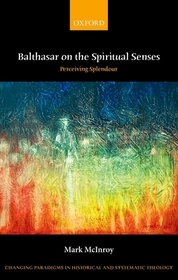
Balthasar on the Spiritual Senses
Perceiving Splendour
Series: Changing Paradigms in Historical and Systematic Theology;
- Publisher's listprice GBP 110.00
-
49 665 Ft (47 300 Ft + 5% VAT)
The price is estimated because at the time of ordering we do not know what conversion rates will apply to HUF / product currency when the book arrives. In case HUF is weaker, the price increases slightly, in case HUF is stronger, the price goes lower slightly.
- Discount 10% (cc. 4 967 Ft off)
- Discounted price 44 699 Ft (42 570 Ft + 5% VAT)
Subcribe now and take benefit of a favourable price.
Subscribe
49 665 Ft

Availability
printed on demand
Why don't you give exact delivery time?
Delivery time is estimated on our previous experiences. We give estimations only, because we order from outside Hungary, and the delivery time mainly depends on how quickly the publisher supplies the book. Faster or slower deliveries both happen, but we do our best to supply as quickly as possible.
Product details:
- Publisher OUP Oxford
- Date of Publication 5 June 2014
- ISBN 9780199689002
- Binding Hardback
- No. of pages230 pages
- Size 221x147x20 mm
- Weight 420 g
- Language English 0
Categories
Short description:
In this study, Mark McInroy argues that the 'spiritual senses' play a crucial yet previously unappreciated role in the theological aesthetics of Hans Urs von Balthasar. The doctrine of the spiritual senses typically claims that human beings can be made capable of perceiving non-corporeal, 'spiritual' realities.
MoreLong description:
In this study, Mark McInroy argues that the 'spiritual senses' play a crucial yet previously unappreciated role in the theological aesthetics of Hans Urs von Balthasar. The doctrine of the spiritual senses typically claims that human beings can be made capable of perceiving non-corporeal, 'spiritual' realities. After a lengthy period of disuse, Balthasar recovers the doctrine in the mid-twentieth century and articulates it afresh in his theological aesthetics. At the heart of this project stands the task of perceiving the absolute beauty of the divine form through which God is revealed to human beings. Although extensive scholarly attention has focused on Balthasar's understanding of revelation, beauty, and form, what remains curiously under-studied is his model of the perceptual faculties through which one beholds the form that God reveals. McInroy claims that Balthasar draws upon the tradition of the spiritual senses in order to develop the means through which one perceives the 'splendour' of divine revelation.
McInroy further argues that, in playing this role, the spiritual senses function as an indispensable component of Balthasar's unique, aesthetic resolution to the high-profile debates in modern Catholic theology between Neo-Scholastic theologians and their opponents. As a third option between Neo-Scholastic 'extrinsicism', which arguably insists on the authority of revelation to the point of disaffecting the human being, and 'immanentism', which reduces God's revelation to human categories in the name of relevance, McInroy proposes that Balthasar's model of spiritual perception allows one to be both delighted and astounded by the glory of God's revelation.
Table of Contents:
Introduction
"In the Spirit of Origen:" Balthasar's Exploration of Patristic Versions of the Spiritual Senses
Balthasar's Reading of Medieval and Early Modern Versions of the Spiritual Senses
The Spiritual Senses in a Modern Idiom: Balthasar's Contemporary Interlocutors
Balthasar's Distinctive Rearticulation of the Doctrine of the Spiritual Senses
Perceiving Splendor: The Role of the Spiritual Senses in Balthasar's Theological Aesthetics
Seeing (Spiritually) is Believing: The Spiritual Senses and Faith
Conclusion

