

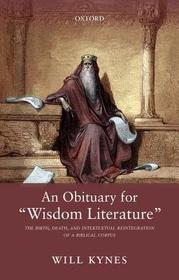
An Obituary for "Wisdom Literature"
The Birth, Death, and Intertextual Reintegration of a Biblical Corpus
- Publisher's listprice GBP 100.00
-
45 150 Ft (43 000 Ft + 5% VAT)
The price is estimated because at the time of ordering we do not know what conversion rates will apply to HUF / product currency when the book arrives. In case HUF is weaker, the price increases slightly, in case HUF is stronger, the price goes lower slightly.
- Discount 10% (cc. 4 515 Ft off)
- Discounted price 40 635 Ft (38 700 Ft + 5% VAT)
Subcribe now and take benefit of a favourable price.
Subscribe
45 150 Ft

Availability
printed on demand
Why don't you give exact delivery time?
Delivery time is estimated on our previous experiences. We give estimations only, because we order from outside Hungary, and the delivery time mainly depends on how quickly the publisher supplies the book. Faster or slower deliveries both happen, but we do our best to supply as quickly as possible.
Product details:
- Publisher OUP Oxford
- Date of Publication 3 January 2019
- ISBN 9780198777373
- Binding Hardback
- No. of pages344 pages
- Size 223x148x25 mm
- Weight 558 g
- Language English 0
Categories
Short description:
This work proposes a radical solution to the problems plaguing the interpretation of Wisdom literature. Kynes identifies the historical origin of the category and critically assesses its development and distorting effect on interpretation.
MoreLong description:
An Obituary for "Wisdom Literature" considers the definitional issues long plaguing Wisdom scholarship. Will Kynes argues that Wisdom Literature is not a category used in early Jewish and Christian interpretation. It first emerged in modern scholarship, shaped by its birthplace in nineteenth-century Germany. Kynes casts new light on the traits long associated with the category, such as universalism, humanism, rationalism, empiricism, and secularism, which so closely reflect the ideals of that time. Since it was originally assembled to reflect modern ideals, it is not surprising that biblical scholars have faced serious difficulties defining the corpus on another basis or integrating it into the theology of the Old Testament.
The problem, however, is not only why the texts were perceived in this one way, but that they are perceived in only one way at all. The book builds on recent theories from literary studies and cognitive science to create a new alternative approach to genre that integrates hermeneutical insight from various genre proposals. This theory is then applied to Job, Ecclesiastes, and Proverbs, mapping out the complex textual network contributing to their meaning. With the death of the Wisdom Literature category, both the so-called Wisdom texts and the concept of wisdom find new life.
Kynes has written a powerful work that forces us to reconsider much we thought we knew and that will probably appear in footnotes for some time. It probably deserves a panel discussion at SBL?though we might wonder which group will be brave enough to do so.
Table of Contents:
List of tables and figures
List of Abbreviations
Introduction
Part 1: Historical Metacriticism
The Rise and Impending Demise of Wisdom Literature: The Modern Scholarly Wisdom Tradition and the Threat of Pan-sapientialism
The Ancestry of Wisdom Literature: Ancient Tradition or Modern Invention?
The Birth of Wisdom Literature: The Nineteenth-Century Origin of the Wisdom Corpus
Part 2: Genre Methodology
The Universe of Texts: The Intertextual Network of Genres from Multiple Perspectives
Part 3: The Reintegration of Wisdom Literature
The Intertextual Network of Job and the Selective Nature of Genre
The Intertextual Network of Ecclesiastes and the Self-Reflective Nature of Genre
The Intertextual Network of Proverbs and the Subjective Nature of Genre
Conclusion
Appendix: Ps 107:40 and Job 12:21, 24 in Commentaries on the Psalms and Job
Bibliography

