

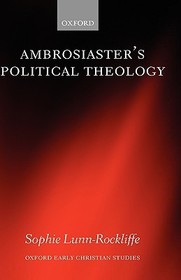
Ambrosiaster's Political Theology
Series: Oxford Early Christian Studies;
- Publisher's listprice GBP 117.50
-
53 051 Ft (50 525 Ft + 5% VAT)
The price is estimated because at the time of ordering we do not know what conversion rates will apply to HUF / product currency when the book arrives. In case HUF is weaker, the price increases slightly, in case HUF is stronger, the price goes lower slightly.
- Discount 10% (cc. 5 305 Ft off)
- Discounted price 47 746 Ft (45 473 Ft + 5% VAT)
Subcribe now and take benefit of a favourable price.
Subscribe
53 051 Ft

Availability
printed on demand
Why don't you give exact delivery time?
Delivery time is estimated on our previous experiences. We give estimations only, because we order from outside Hungary, and the delivery time mainly depends on how quickly the publisher supplies the book. Faster or slower deliveries both happen, but we do our best to supply as quickly as possible.
Product details:
- Publisher OUP Oxford
- Date of Publication 4 October 2007
- ISBN 9780199230204
- Binding Hardback
- No. of pages224 pages
- Size 223x145x18 mm
- Weight 404 g
- Language English 0
Categories
Short description:
A study of the writings of the late-4th-century Christian writer Ambrosiaster, whose works were influential on his near contemporaries and throughout the Middle Ages. Sophie Lunn-Rockliffe discusses his political theology and also addresses the problem of the author's mysterious identity, placing him in a broad historical and intellectual context.
MoreLong description:
The works of Ambrosiaster, a Christian writing in Rome in the late fourth century, were influential on his near contemporaries and throughout the Middle Ages. In the first half of her study, Sophie Lunn-Rockliffe addresses the problem of the author's mysterious identity (which scholars have puzzled over for centuries) and places him in a broad historical and intellectual context. In the second half she addresses Ambrosiaster's political theology, an idea which has been explored in other late Roman Christian writers but which has never been addressed in his works. She looks at how Ambrosiaster's attitudes to social and political order were formed on the basis of theological concepts and the interpretation of scripture, and shows that he espoused a rigid hierarchical and monarchical organization in the church, society, and the Roman empire. He also traced close connections between the Devil, characterized as a rebel against God, and the earthly tyrants and usurpers who followed his example.
A remarkable study of the anonymous Latin writer in fourth-century Christian Rome... to Sophie Lunn-Rockliffe we are indebted for a well-annoted commentary on an important Latin Christian text.
Table of Contents:
I. Ambrosiaster's writings and identity
The emergence of Ambrosiaster
Ambrosiaster's background
Ambrosiaster's ecclesiastical context
II. Ambroasiaster's political theology
Social hierarchies
Ecclesiastical hierarchies
Divine kingship
Diabolical tyranny
Conclusion

