

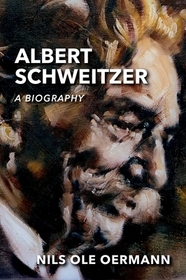
Albert Schweitzer
A Biography
- Publisher's listprice GBP 53.00
-
23 929 Ft (22 790 Ft + 5% VAT)
The price is estimated because at the time of ordering we do not know what conversion rates will apply to HUF / product currency when the book arrives. In case HUF is weaker, the price increases slightly, in case HUF is stronger, the price goes lower slightly.
- Discount 10% (cc. 2 392 Ft off)
- Discounted price 21 537 Ft (20 511 Ft + 5% VAT)
Subcribe now and take benefit of a favourable price.
Subscribe
23 929 Ft

Availability
printed on demand
Why don't you give exact delivery time?
Delivery time is estimated on our previous experiences. We give estimations only, because we order from outside Hungary, and the delivery time mainly depends on how quickly the publisher supplies the book. Faster or slower deliveries both happen, but we do our best to supply as quickly as possible.
Product details:
- Publisher OUP Oxford
- Date of Publication 24 November 2016
- ISBN 9780198784227
- Binding Hardback
- No. of pages282 pages
- Size 203x132x21 mm
- Weight 398 g
- Language English 0
Categories
Short description:
Albert Schweitzer was a German-born French theologian and biblical scholar, philosopher, missionary, doctor of medicine, and accomplished interpreter of Bach's organ music. Professor Oermann's biography draws on newly uncovered personal papers and attempts to do justice to Schweitzer's multifaceted life, work, and thought.
MoreLong description:
This biography provides a versatile insight into the life, work, and thought of Albert Schweitzer (1875-1965). Nils Ole Oermann offers a detailed account of the multifaceted life of Albert Schweitzer who was a theologian, organist, philosopher, physician, and medical missionary. Schweitzer's life was not a straight path from the parsonage in Alsace to the University of Strasbourg, then on to the hospital in Lambarene, and ending with the Nobel Peace Prize in Oslo. In every life there are highs and lows, victories and defeats--and Schweitzer's life was no exception. These ups and downs, however, are barely discernible in Schweitzer's 1931 autobiography, Out of my Life and Thought, where he presents his life as an enormous, purposefully constructed edifice, the cornerstone of which was the principle of Reverence for Life, and the almost inevitable outcome of which was the Nobel Peace Prize. To date, biographers, journalists, and hagiographers have told and retold the story of Schweitzer following this basic pattern with relatively little critical modification. Their Schweitzer was a man whose demeanour and charisma set him apart from other intellectual giants of his time. But not everything Schweitzer records in his autobiography corresponds with what is found in the archives and in his unpublished writings. It is on the basis of these historical sources and more recent publications that Oermann attempts to sketch a more realistic picture of Albert Schweitzer. Oermann draws on newly uncovered personal papers which shed light on Schweitzer's dealings with the East German authorities and his role in the anti-nuclear movement. He also builds on a number of interviews from those associated with Schweitzer--most notably his daughter.
Schweitzer carefully constructed a lasting and often romanticized self-image through a number of biographical reflections, interviews to journalists, and film documentaries ... Oermann offers a more complex image of Schweitzer
Table of Contents:
Introduction
A sense of devotion: from the parsonage to theology (1875 1903)
A pastor s son in Alsace
Schooling and early years
A student of theology, philosophy, and music
Kant
Curate, doctoral student, and outsider
Theologian or mystic?
Saving the whole: from theology to Bach and then to medicine (1903 1912)
Bach, or the art of playing the organ
The path to a decision
The study of medicine
The loyal comrade
The spiritual adventurer: from Strasbourg to the rainforest and back again (1912 1917)
Departure to equatorial Africa
Lambarene
The outbreak of war and deportation
It is good to preserve life: Albert Schweitzer s philosophy of civilisation
We are all of us just nothing but epigoni
Reverence for life
Philosophy of civilisation and religion
The importance of animals
The iron door opens: crisis and breakthrough (1917 1932)
Return to Alsace
The lost penny
Back in Lambarene
On the right treatment of natives
With greetings from Central Africa: the time of the Third Reich (1933 1945)
The calm before the storm
Lambarene during the war
Exorcising the ghost of the nuclear war: Schweitzer in the Cold War (1945 1957)
The greatest man in the world
The Nobel Peace Prize and its consequences
Schweitzer, Einstein, and the bomb
A bell from the German Democratic Republic
Homo politicus
How beautiful! The last years (1957 1965)
Decolonization and criticism
The ninetieth birthday
Epilogue: myth and reality
Timeline
Explanatory Notes

